Book Reviews (by Kim Gentes)
In the past, I would post only book reviews pertinent to worship, music in the local church, or general Christian leadership and discipleship. Recently, I've been studying many more general topics as well, such as history, economics and scientific thought, some of which end up as reviews here as well.
Entries in Book Review (90)
Culture Of Honor: Sustaining A Supernatural Environment - Danny Silk (2009)
 Saturday, April 20, 2013 at 12:33AM
 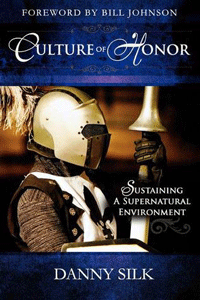 Church government is a topic that has as many opinions as there are churches. In fact, though the Bible talks little about church government directly, it is a main point of distinction among many Christian groups. This is both sad and telling of our fractured world and the bride of Christ. Because of this lack of cohesion, teaching and discussion among Christians on this topic, there are few writings on the subject that don't devolve into particularism.
One book I have recently read on this subject is Danny Silk's "Culture of Honor: Sustaining A Supernatural Environment". Silk is a senior staff member at Bethel Church in Redding California, most known for its popular leader, Bill Johnson. "Culture of Honor" is a different approach to church government than you might expect. It's main distinctive is embedded in the title of book- that the honor of people is the only way to true leadership of those same people. This is stated upfront in a succinct definition:
The Principle of Honor states that: accurately acknowledging who people are will position us to give them what they deserve and to receive the gift of who they are in our lives.1
Silk provides both strong points and excellent personal/church examples of those points throughout the book. The examples shine of the vibrancy of mercy, wisdom and faith that takes both God and people seriously. It is clear that Silk (and the book therein attributes this clearly also to Bethel) is looking to undermine the assumption of a business world influenced hierarchical church government and supplant on it primarily the pastoral care of mercy and wisdom within the context of a relational, not structure, based leadership. This is somewhat ironic because one of the main refutations that the book makes is actually a claim against the role of pastoral office as a primary overseer of the local church. But I will return to that later.
What I love about this book is it's common sense, and biblically based, understanding of its main thesis- that we are to honor people with the assumption of good in our hearts. Judgment is not an option, and even as leaders, we do not assume acts of "church discipline" are the first solutions to people's failures. In fact, Silk is almost masterful in his application of the Socratic method (guiding people through asking questions as a way of self-discovery) of pastoral counseling. He knows, like great leaders in history have always known, that people change only through internal acknowledgement and willingness to do so. This can often only come when those people are empowered through revelation of their own situation, failures, misunderstandings and sin. None of this can be imputed (and make a heart change) by typical "instructive" methods. Silk rightly leans on this key point:
Asking the right questions in the right way is one of the keys to creating a safe place.2
The author culminates a series of excellent examples into several poignant truths, debunking the need to chastise people into submission, and taking the message of Jesus mercy as the prevailing guideline for our actions, rather than the judgment and criticism so prevalent in many church governmental structures. He confronts this issue of judgment and its fallout head-on:
What offense does to you is it justifies you withholding your love. I get to withhold my love from you when you have broken the rules, because people who fail are unworthy of love, and they deserve to be punished. In fact, what punishment looks like most often is withholding love. And when I withhold love, anxiety fills the void, and a spirit of fear directs my behavior toward the offender.3
This brilliant statement is a cogent explanation of so many of Jesus teachings on leadership and sin, especially the specific lessons he was pointing to in his parables of the good Samaritan and the prodigal son. Silk, and Bethel, seem to have found an articulation for how to apply these deep truths that rises above the need to control people, based on their fear of "getting messy" with difficult situations and people. The book pivots on the idea that "we are un-punishable"4, which is related not only as a core value but a culture changing reality for the church and the world- and who can argue with him! Silk has found in church government a place in dire need of the cross and Christ's work on it- the mercy of God, removing judgment from our realm to God's.
For these points, "Culture of Honor" is one of the best books you can read on church leadership and how to lead in relational grace rather than shaming or controlling people into "Christian behaviors". Interestingly enough, after recently finished reading Brené Brown's "Daring Greatly", I found that "Culture of Honor" is (at its core) a biblical exposition of the truths Brown discovers (through her research), that shame ultimately always fails as an effective motivator and leadership tool. An odd juxtaposition, to be sure, yet these books are linked in their foundational message of leaving shame-based methods and moving to forms of trust (in Brown's book vulnerability; in this book faith) that provide relational, not positional, power to influencing others.
Silk is expressive in his passion for his viewpoint and one can't argue with his experience for which he claims to be witness to the power of his model being operable- presumably, the church community he is a part of thrives in the leadership architecture of he describes in the book. As I said, I enjoyed the book and found its primary points- honoring people, valuing their worth, Socratic-method counseling/pastoral care, creating safety in community and confrontation, the value of Christ's work making us un-punishable, avoidance of shame-based manipulation, faith/risk/vulnerability, reliance on the Holy Spirit, viewing the "on earth as it is in heaven" of Matt 6 as the primary perspective of God's kingdom intersecting and invading our real world, the inclusion of apostolic and prophetic ministries as essential components to local church leadership- to be excellent examples of the mercy-centered orthopraxy from which Jesus himself modeled ministry.
But to give this review its full treatment I must state where I felt the book falls short of what appears to be one of its main goals- to establish a new "order" of hierarchical rank in local church government. Specifically, Silk uses 1 Corinthians 12:28, which says "And God has appointed in the church, first apostles, second prophets, third teachers, then miracles, then gifts of healings, helps, administrations, various kinds of tongues."5 to attempt to justify this assumption about a hierarchical order of church government:
Paul clearly lays out an order of priority in this passage, and this order is related to the realms of the supernatural that correspond to each particular office.6
From this assumption, the author builds a lengthy argument and reasoning around establishing apostles as the current positions which should play the foundational role in church government. The problem is, he does not substantiate it well from scripture. One has to make the interpretive jump with Silk that "first...second...third" was implicit to authority and NOT to order of operation or a timeline. Further, the context of this entire section of Corinthians is actually the inverse point that the Silk is trying to draw from this single passage in a few ways.
View a detailed review of points that I felt were poorly made in this book.
This is disheartening, because (as I mentioned at the outset) this book has some excellent things to say. I love the main premise (and title) of the book, I agree with much of the foundational and grace-centered basis of the Bethel approach to leadership and conflict resolution, and I even like the important reconsideration of the roles of apostle and prophet into the local church government. However, the support and exploration of the church governmental theory is so poorly done as to undermine the value of the hypothesis. I am not even saying the hypothesis couldn't be true- I just don't think this book does a good job of doing that. Also, the tone of the book, at times, does not help endear the reader to give more benefit of the doubt to the author. At times, it sounds self-assured and perhaps even condescending to those who might not agree (a la "you might think you know, but listen, we've got this figured out"). I just think a bit more language of "consider this" throughout the book would have taken it from being a book that sounds sure of itself, to being one that church leaders might want to chew on and consider its points more seriously.
In the end, despite my long and detailed comments of frustration (mentioned above), I strongly recommend people read this book. Especially to any church leaders who are looking for insightful perspectives on church government. Struggle with this book, as I did. Read the stories, be inspired by them. And try to untangle the disconnected logic from the main ideas. As one church leader said "eat the meat, spit out the bones". I initially read this book as an assignment, and when I was finished I thought "I could definitely serve at a church with that model". I'd use this book to explain the model- as it does that well- I just wouldn't try to use this book to defend it.
Amazon Link: http://amzn.to/11qULKf
Review by Kim Gentes
1. Silk, Danny (2009-12-28). Culture of Honor: Sustaining a Supernatural Enviornment[sic] (Kindle Locations 179-180). Destiny Image. Kindle Edition.
2. Ibid., (Kindle Locations 318-319)
3. Ibid., (Kindle Locations 1076-1079)
4. Ibid., (Kindle Location 1181)
5. Ibid., (Kindle Location 566-568)
6. Ibid., (Kindle Location 569-570)
7. Ibid., (Kindle Location 720-721)
8. The prophetic model of Old Testament scripture, that Jesus did come to fulfill, is one of a Godly criticism to the people of Israel. Unlike our idea of explaining the future, most of what is labeled prophetic in the old and New Testament is the balancing critique of Gods voice. Often confronting, correcting compelling and reframing people's expectations and worlds against the call of God. Again, prophetic certainly does have a revelatory nature of all its operation but its clear that scripture most often has it as a balancing voice of insight meant to keep the Israel/the church from become self focused.
9. Silk, Danny (2009-12-28). Culture of Honor: Sustaining a Supernatural Enviornment[sic] (Kindle Location 746-747). Destiny Image. Kindle Edition.
10. Ibid., (Kindle Location 1326-1328)
The Road To Serfdom - F. A. Hayek (1944)
Thursday, April 18, 2013 at 8:00PM 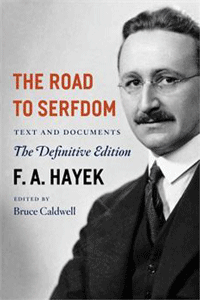 Of the thousands of pages of text among the dozens of now iconic books written on economics, there is no more succinct and penetrating exploration of the ties of economic capitalism with political liberalism than the relatively short work of "The Road To Serfdom" by Friedrich A. von Hayek. Having read several of these voluminous texts myself, I can say unequivocally that "The Road To Serfdom" is the singular text that simultaneously explains the simplicity and benefits of the free market system while profoundly destroying the notion that personal liberty could be found within the socialist economic framework. Hayek, as he admits of himself, is an academic and technical economist who felt compelled to write a defense of the basics of liberalism (in the 19th century classical definition) as the unique and necessary combination of economic freedom and personal liberty only after it was clear that many of his influential political contemporaries in WWII Europe had vastly misunderstood the workings of socialism, and that it's ultimate outcome would always be totalitarianism- either in the form of Communism, as in Russia, or in the form of Fascism, as in Nazi Germany.
In fact, this book outlines the progression of what exactly happened in Germany to produce the society and opportunity for Hitler's regime to become the tyrannical monster of the modern world. Hayek clearly and convincingly explores how the fears of individuals based in economic instability of a free market system can lead people to eventually surrender their individual liberties in hopes of economic and nationalistic security. This surrendering becomes a downward spiral of personal liberties as the willing (at least initially) cost of an ever-expanding socialist economic state. A state in which the individual hopes of security and sustenance become permission for an eventual autocracy that maintains all decisions for all peoples at all times.
The observations of Hayek are not meant merely as a history lesson, but were a clear warning to England and America of the dangers of socialist economic thinking (and socialism in general), because Hayek believed that the rise of socialism in those countries would eventually set the stage for a totalitarian regime to be possible. In fact, Hayek's thesis and warnings are so cutting, and so well defended that he almost single-handedly inspired a renaissance of 20th century liberalism (though it more often went by the label of conservatism by its adherents such as Margaret Thatcher and Ronald Regan).
"The Road To Serfdom" is not just about the political and economic threads that led to Nazi Germany, it is about the true balance of power between personal liberties and state control. If you have never read an economics book in your life, you MUST read this one. It is by far the most powerfully written, yet simply understood, philosophical explanation of liberalism and the free market system- and why the combination of free market economy is the central component to ensure the other freedoms that accompany modern liberty (emancipation, universal suffrage, free speech and more). The ability to make self-determined decisions about work and economic exchange imbues in itself the power to allow both individuals and entities to pursue success. The natural balance of the free market is not only clearly articulated, Hayek contrasts it with the inherent weaknesses of the planned economic socialist state.
This is a political book, but whatever your politics are- you cannot afford to ignore this book. Whatever your political understanding or persuasion, this book is an absolute "must read" text. While books like Mises' "Human Action" and Adam Smith's "Wealth of Nations" provide more technical details and examples on how the free market system works, neither of those books provide so clear and convincing a treatise on the benefits and perpetual health of a economic liberalism, as "The Road to Serfdom".
Once beginning to read this book 4 days ago, I could not put it down. I am now on my third time through and continue to find it as enthralling and engaging each time through. A truly brilliant articulation of economics, freedom, free market, and the dark path of socialism that eventually leads to totalitarianism. If you believe you understand economics and have never read this book, you have missed one of the greatest texts in this field, in history.
Amazon Link: http://amzn.to/XJKd8j
Review by Kim Gentes
Daring Greatly - Brené Brown (2012)
Monday, April 15, 2013 at 4:46PM  "Daring Greatly" is a brilliant and well-founded book that explores the relationship between vulnerability (and its antithesis- shame) and the human ability to thrive in various aspects of life. Researcher, professor and speaker Brené Brown presents a comprehensive treatise on the strength of weakness as encapsulated in the concept of vulnerability. Basing the book on almost a decade of grounded theory research, Brown pours out a narrative of our society: grounded in a culture of scarcity, steeped in shame, disengaged and dehumanized, we've become ineffectual and immobilized by our vices while remaining skeptical of a solution from the weak-kneed concept of vulnerability. Into that realm, she categorically refutes the myths of vulnerability and builds a bulwark of understanding, combating and refuting shame. By juxtaposing these two concepts- vulnerability and shame- the author gives practical tools for people to begin to reframe their approach to everything from work, to mission, to relationships and even to parenting.
What endears this book to the reader is its terse and pithy style in which Brown's "Texas-attitude-meets-Ivy-league-education" approach draws both research and reality into sharp focus. Brené Brown may be as brilliant a writer as she is a researcher, and one can only hope that she is as resilient with this kind of writing as her formula for combating shame-based systems. Her examples, her categorizing and her structure of the book brought me along effortlessly. Every time it seemed that she was about to run ashore with data, psychobabble and information overload, she would pull out another human story of what she was talking about. OK, I'll admit it. I welled up with tears a few times reading this book. Especially the parts that were about things I have dealt with, such as parenting, shame, work (success and failure) and more. Rather than make up hypothetical cases, Brown peppers this book with real life. The kind of real life that hits you in the heart like a sucker punch in the solar plexus.
The only "fault" I could find with this book was its later-half renditioning of iterated concepts into named "manifestos" and "checklists", which feels to this reader like a liturgical social contract that perhaps adds its own very tiny hint of shame to those who already feel burdened down by the expectations and shame this book otherwise so powerfully addresses. I say this not to berate the author's work, but merely to point out that it is the nomenclature of "manifesto" and "checklist" that perhaps places them on another long "To-do" list that our shame-laden society is already struggling to stand up under. I will take the great advice given in them as helpful, but may not want to call it a "manifesto"- a term which has so much charge and grandiosity as to make ignoring it something of a shame.
That point aside, the book explodes the heart with joy from every corner. The topics covered will be of interest to literally every person in western society. Who is not driven by the pressures of shame, afraid of the weakness of vulnerability, and out-gunned by the societal pressures of being the perfect parent? I absolutely LOVED what Brené Brown says about parenting. I finally saw some actual explanation behind the occasional times of glistening success I've felt as a parent, and some solid solutions for parenting issues I am still struggling with. The chapter on parenting, alone, is worth the entire price of the book, although, frankly it makes little sense until you've read the rest of the book (as it appears, fittingly at the end of the volume). It is excellent and penetrating in its clarity of the essential aspects of relational connection and leadership with our children. To cite just one example (from which are many) is this obvious and brilliant axiom that emerges in her writing:
What do parents experience as the most vulnerable and bravest thing that they do... the answer was obvious: letting their children struggle and experience adversity.1
This is just a sample of Brown's common sense reality that mixes well with her deep research background to create a brilliant collage of wisdom in this chapter.
Now, finally, to my absolute most loved part of the book- the appendix. Call me a geek, and you'd be throwing a big stone into my glass house for sure. In the appendix Brown explains her particular approach to research theory and process. Her work has been taken seriously because she took it seriously. This was not a book written out of convenience or conjecture. Brown is driven by research. This is what I LOVE about this book, and from it comes an appreciation that has me reading it through a second time.
I've got to admit something. I don't like reading pop-psychology books. I especially don't like when they become phenoms that garner tabloid level press and afternoon talk show appearances. My disinclination to this kind of writing made me wince when I had found out that (after I had downloaded the book to my Kindle), it was widely celebrated in just these kinds of arenas. But Brown's research, excellent writing and incredibly practicable solutions (that she details therein) dispel all of my concerns of being one of the "mob" running after the "hot fad" in pop-psych.
This book is excellent, timely, deep (but not technical), caring and enjoyable. An astounding feat in just 250 pages of text that fly by in a couple days. If you have time to read just one book this year, make it this one. You won't regret it.
Amazon Link: http://amzn.to/106XPOt
Review by Kim Gentes
1. Brown, Brene (2012-09-11). Daring Greatly: How the Courage to Be Vulnerable Transforms the Way We Live, Love, Parent, and Lead (p. 238). Penguin Group US. Kindle Edition.
Simply Jesus - N.T. Wright (2011)
Monday, April 8, 2013 at 8:40PM  The central character of all Christendom is, of course, the person of Jesus. Yet, across even the Christian community there is much conjecture about some of the main tenants of the faith. An understanding of who Jesus is, why he came and what he accomplished are essential. Historian and theologian N.T. Wright approaches this subject as both a scholar and pastoral leader by combining the major points of his thesis from "Jesus & the Victory of God" (a complex scholarly graduate-level book) and the summarizing of "The Challenge of Jesus" (a much smaller book for local churches). Wright attacks the questions that people have about Jesus as a real, historical figure and the claims which Christians often take as "normal" for the faithful. But rather than deep technical renderings of logic and argument (such as his repudiations of others such as Dominic Crossnan in "Jesus & the Victory of God"), Wright focuses simply on explaining most of his reasoning from the scriptures themselves and drawing the backdrop from his work in history.
Wright does a brilliant job of explaining what he considers is the "real Jesus", one based on the historical context of the social, political and religious forces at work in the time of Jesus on earth. He does this primarily by explaining the three main forces driving the context for the narrative of the Gospels. The first force is the Roman empire and its dominating political and military control that crushes down on the middle east and the people of Israel. The second force is the ethos and history of the Jews, especially as it has been galvanized by the Maccabean dynasty, whose rebellious origins are the archetype for a series of nationalistic uprisings meant to free the Jews from a stream of dominating overlords (including the Greeks/Persians, Egyptians, Syrians, Parthians and Romans). The last great force is the self-critical voice of the prophetic tradition of the Jewish prophets. Wright explains each of these "forces" as a type of storm system which come together in the time and story of Jesus appearance to contribute to a kind of "perfect storm". Jesus positions his message- the kingdom of God- as the singular clear response to this perfect storm.
It is in the midst of this meteorological metaphor that Wright explains Jesus vocation with this brilliant language:
And with that, the sea is lashed into a frenzy; the wind makes the waves dance like wild things; and Jesus himself strides out into the middle of it all, into the very eye of the storm, announcing that the time is fulfilled, that God’s kingdom is now at hand. He commands his hearers to give up their other dreams and to trust his instead. This, at its simplest, is what Jesus was all about.1
What I love about this book is that the author is very clearly speaking to "everyman" here, and yet he still takes the opportunity to teach valuable history and theology. This book is poignantly underpinned by Wright's foundational understanding of Jesus as the herald announcing, enacting and resetting our definition of God as the new king progressively taking over earth. Jesus reconstitutes the sacred symbols of temple and time around himself, which is the ultimate repudiation of Jewish religious systems and leaders- which is what leads to his death. Wright also makes it clear that Jesus was calling for a complete revolution and was himself a revolutionary leader in every aspect of the word- except military. Jesus announcement of a "new kingdom" could not, and would not, be seen as non-political, and the degree to which it was reinforced the Roman engagement (along with the Jewish leader's angst) in Christ's eventual crucifixion. The author doesn't say that it is only political, but that Jesus was calling for a new king in charge- God himself- in every aspect of cultural, familial and political sphere.
The final, short section of the book deals with the results of Jesus claims as they are played out in the lives of his disciples and the early church.
I very much enjoyed this book by N.T. Wright. I feel it has more accessibility than many of his books, and obviously that is the intent here. He succeeds. It is also a very convincing coalescence of several of his themes presented in other books (the aforementioned, as well as "How God Became King"). He does this through his well paced metaphor (perfect storm) without descending into the depths of critical historical argumentation.
Amazon Link: http://amzn.to/16KZMgH
I highly recommend this book.
Review by Kim Gentes
1. Wright, N. T. (2011-10-25). Simply Jesus: A New Vision of Who He Was, What He Did, and Why He Matters (p. 56). HarperCollins. Kindle Edition.
Human Action: A Treatise On Economics [Scholar's Edition] - Ludwig von Mises (1949)
Saturday, April 6, 2013 at 9:46AM 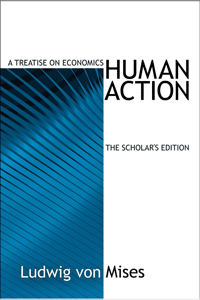 Economics is often a much maligned area of study. Say the word "economics" to a bunch of bankers and you will doubtless get endless theories of investment vehicles, interest rate charts and inflation debates. Say the same word to government officials and you will get long monologues on monetary policy, interventionism vs social responsibility and unemployment numbers. Say "economics" to a person balancing their checkbook or a small business owner and you will get responses about debt, taxes, capital expenditures and return on investment. However, each of these responses are centered around a manifestation of economic ideas- but they are not truly what economics is. In the massive volume "Human Action: A Treatise on Economics", Austrian professor Ludwig von Mises explains economics as the meaning and conduct of people towards a specific end. It is, above all else, action and its meaning. To quote von Mises:
Economics is not about things and tangible material objects; it is about men, their meanings and actions.1
To grasp von Mises entire thesis, you must understand his perspective for which economics is primarily aiming. Specifically, von Mises believes that action is taken to achieve a goal. He says:
Strickly speaking the end, goal, or aim of any action is always the relief from a felt uneasiness.2
For von Mises, the study of economics is the study of human actions meant at achieving relief from uneasiness (or "want satisfaction"). Based on that premise, "Human Action" became the seminal text of what is commonly called the Austrian School of economics. The book is long (about 1150 pages) and delves as much into the nature of human decision making as it does in its results. It is for this reason that the book is rife with long and detailed arguments in support of laissez-faire economics and the free enterprise system as the only way in which successful "want satisfaction" can be achieved for the broadest benefit of the society. Most succinctly, von Mises ties the ideological superstructure of liberalism, constitutions, bills of rights, and laws- all forms of social, religious and political freedoms- to their counterpart in economic freedom that is instantiated in free market system of modern capitalism. Ludwig von Mises spares no words on his socialist, interventionist and Marxist counterparts, and provides extensive and clear explanations on the errors of such economic thought.
The author provides deft guidance to his book's approach in these introductory sentences:
What is commonly called the "industrial revolution" was an offspring of the ideological revolution brought about by the doctrines of the economists. The economists exploded the old tenets: that it is unfair and unjust to outdo a competitor by producing better and cheaper goods; that it is iniquitous to deviate from the traditional methods of production; that machines are an evil because they bring about unemployment; that it is one of the tasks of civil government to prevent efficient businessmen from getting rich and to protect the less efficient against the competition of the more efficient; that to restrict the freedom of entrepreneurs by government compulsion or by coercion on the part of other social powers is an appropriate means to promote a nation's well-being. British political economy and French Physiocracy were the pacemakers of modern capitalism. It is they that made possible the progress of the natural sciences that has heaped benefits upon the masses. What is wrong with our age is precisely the widespread ignorance of the role which these policies of economic freedom played in the technical evolution of the last two hundred years. People fell prey to the fallacy that the improvement of the methods of production was contemporaneous with the policy of laissez faire only by accident.3
"Human Action" is not a book for casual reading, and requires you to learn and maintain a new subset of vocabulary which will be needed for interpreting this book. The terms "praxeology" (which means, actions) and "catallactics" (meaning- exchanges) are used hundreds of times and become self-evident within the text, but von Mises layers on this dozens of words which have limited meaning outside of scholars and university studies. Still, the book is deeply enthralling. If you are a logician, you will find his arguments and structured presentation to be euphoric.
Above everything else, Ludwig von Mises is a champion of freedom. Certainly, this thesis aims at the freedom of economics, but he attacks, and defeats with logic, dozens of misguided theorems which come from the the impulse of people to control others. It seems he doesn't believe in capitalism because of its benefits only, but because it is an expression of freedom, as much as speech, political liberalism, freedom of religion and any other form. In that vein, he confronts the manifestations of doctrines which oppose freedom up to and including war-mongering. His summary sentences on aggression are poignant and brilliant:
How far we are today from the rules of international law developed in the age of limited warfare! Modern war is merciless, it does not spare pregnant women or infants; it is indiscriminate killing and destroying. It does not respect the rights of neutrals. Millions are killed, enslaved, or expelled from the dwelling places in which their ancestors lived for centuries. Nobody can foretell what will happen in the next chapter of this endless struggle. This has nothing to do with the atomic bomb. The root of the evil is not the construction of new, more dreadful weapons. It is the spirit of conquest. It is probable that scientists will discover some methods of defense against the atomic bomb. But this will not alter things, it will merely prolong for a short time the process of the complete destruction of civilization. Modern civilization is a product of the philosophy of laissez faire. It cannot be preserved under the ideology of government omnipotence. Statolatry owes much to the doctrines of Hegel. However, one may pass over many of Hegel's inexcusable faults, for Hegel also coined the phrase “the futility of victory” (die Ohnmacht des Sieges). To defeat the aggressors is not enough to make peace durable. The main thing is to discard the ideology that generates war.4
This is just one example of von Mises broad but systematic approach to understanding human action and its good and bad forms of expression. This example highlights his broadness of vision, his highly developed understanding of philosophical underpinnings of humanity, and above all, his ability to clearly distinguish the ideas of human intention from the realities of human action.
Of course, there are the long and extensive descriptions of dozens of items such as monetary, inflationary, and governmental policies, interest rates, free trade, taxation, theory of value and much more.
What you gain from reading the book is an exploration of the ideas and motivations that lead to decisions, that produce specific results, and that assist or hamper the actual perpetuation of a free market system. This is a scholarly book and delves deeply into its subject of praxeology and catallactics. The minor errors with this book are centered mostly around the attempt it makes to be progressive relative to the time of writing- by including relevant "current" examples, the subject and examples are dated to the era in which the original and revisioned versions were printed. None of us can escape our time period of existence, but Mises exposes some of his own prejudices and angst by doing so. The book could have done without those. At times as well, his deriding of socialist and interventionist motivations run far deeper than probably most people's intentions who take opposing views. It is understandable that Mises is trying to hold serve against the prevailing Keynsians and New Deal advocates of his era, but at times Mises rhetoric becomes so sarcastic as to be vitriolic.
However, we can forgive both these misteps partly because it would take such a strong and detailed opposing voice (which von Mises provides therein) to successfully dismantle the vices and embedded character of government planning, control, and what Mises would consider socialist economic agendas. We can further forgive von Mises because, in the end, he wins. The fall of almost every communist and social planning state in the world (most of which collapsed or revolted during the 20th century) was the ultimate proof that the free market system is its own validation. As is proven by many other texts and studies, capitalism is the resulting manifestation of liberalism being played out in the realm of economic reality- and that reality, however cyclical and unpredictable, has proven for the last 300 years to the be the only system which could produce vast increases in the production, standard of living and per capita income of its entire population. We can forgive Mises bluntness for the simple fact that he has been proven right.
The book "Human Action" has became the bedrock of Austrian School economics and the cited source that grounded much further work from champion economists who took up the banner of free market thinkers such as Milton Friedman and others. One need not agree with all the sharp criticisms of von Mises towards his opponents, but we are shocked to find out how much of his sharp criticism (that might have sounded preposterous at the time of writing) now seems all too obvious in its results in reality. If you are studying economics, this will doubtless be one of the main works you must read to be thoroughly informed. While it is exceptionally articulate and filled with specifics, it remained unfettered by meaningless side notes (which is often common in economics texts).
An iconic and foundational book on the study of economics from the view of classic liberalism. A landmark.
Amazon Link: http://amzn.to/ZoxhYX
Review by Kim Gentes
1. Mises, Ludwig von (2009-03-30). Human Action: Scholar's Edition (LvMI) (Kindle Location 2413). Ludwig von Mises Institute. Kindle Edition.
2. Ibid., (Kindle Location 2406)
3. Ibid., (Kindle Location 856-865)
4. Ibid., (Kindle Locations 16189-16199)