Book Reviews (by Kim Gentes)
In the past, I would post only book reviews pertinent to worship, music in the local church, or general Christian leadership and discipleship. Recently, I've been studying many more general topics as well, such as history, economics and scientific thought, some of which end up as reviews here as well.
Entries in Book Review (90)
After You Believe: Why Christian Character Matters - N.T. Wright (2010)
 Sunday, October 12, 2014 at 1:40AM
  After You Believe - NT WrightLike all NT Wright books, "After You Believe: Why Christian Character Matters" tackles a specific topic or area with an aim to provide scriptural and historical context as a foundation for the author's theological and philosophical positions on the topic. Wright always does his research and this book is no exception. "After You Believe" tackles the topic of character by looking at the ancient Aristotelian concept of virtue and how it was reimagined and reformed by the theology and practice of both Jesus and Paul.
The book is a treatise exploring a Christian virtue ethic in which the believer takes on the assumptions of character transformation through gradual surrender to God's kingdom concepts of worship and mission. More specifically, this is not a book about the "how-to's" of Christian practice.
What you find here is NT Wright continuing his conversation about how not only our theology, but our practice, must anticipate the full appearing of kingdom of God in it's action. That is to say, Wright's vision of a Christian virtue ethic is based on eschatology (where we are headed) and how full human flourishing occurs as we make the journey there, beginning in this world, not the next.
"After You Believe" is a subtle side-swipe of the standard "spiritual disciplines" talk that has come through in many popular Christian books. Wright has little patience for "self-help" Christian concepts, and debunks the "God-less do-gooding" as much as he deconstructs the popular notion of "cheap grace" - both of which he considers errant parodies of true Christlikeness. In fact, this book nods at Aristotle's astute observations of virtue, and yet, explains that Jesus and Paul answered the ancient Greek notion of virtue with the true answer to human flourishing - love-fueled Christlike character.
NT Wright has done with "After You Believe" what he has done with many other New Testament topics- re-addresses them in light of his creational theology that puts God's goal of rescuing humanity from it's sin stained condition and restoring the future of our created intention through Christ's work on the cross and the Holy Spirit's presence with the church through the ages. This book is vivid, powerful and readable. But it is not simple. It requires you take seriously the concepts he brings to bear in his other books (though he leave you enough overview in this book, even if you haven't read the others).
The purpose of this book is pragmatic (explaining to Christians what they are to do in this life, while waiting for the glorious eternity in the next), but it has a powerful, perhaps eternal intent- to get us walking towards the future in the area of our character, long before the future fully arrives.
It is an excellent book on, as Wright puts it "how to think about what to do". Get it. Read it. You will not be disappointed. A great book from a great thinker about a topic that is of great importance to all Christians.
Amazon Link: http://amzn.to/1sgmqsU
Review by Kim Gentes
EntreLeadership - Dave Ramsey (2011)
Tuesday, October 29, 2013 at 12:53AM 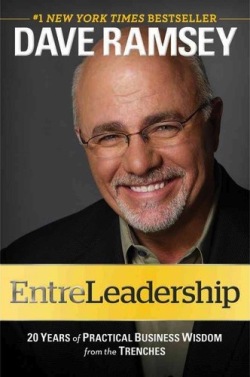 I've read business books. I've read leadership books. But what I haven't read is a real, honest-to-goodness, practical play-book of how to do small business. Until now. Dave Ramsey's book, EntreLeadership, is just that- a fairly comprehensive and integrated manual for growing small businesses that (whether they know it or not) will need training in leadership development and core business skills. For those that don't know, Dave Ramsey is a radio show talk personality who largely is known for his on-air advice to callers on the topic of personal finance. Something of a combination of Suzie Orman and Clark Howard, with Christian values contextualizing his perspective, Ramsey is strongly opinionated but has proven to be practical and effective as an advisor on money matters, especially concerning the topic of debt.
Ramsey's advice and radio show have been the centerpiece of a company that also sells products and training services to millions of people looking to manage their finances and pay off their debts. The success of his sales of those goods and services has turned him into the leader of a small but growing and successful enterprise in its own right. The author clearly knows what it takes to actually build a business, and he understands how to effectively dissect and represent good thinking about the strategies that can be transferable to other people. In short, Ramsey is as capable a coach as he is an implementer, and this is a rare trait.
EntreLeadership not only defines the generalities of vision, mission and goals, he gives play-by-play details on very well thought out execution plans for sales, marketing, employee management, financial oversight, leadership and much more. Actually, I found that Ramsey abbreviates points I've heard in other books, but does so with sharper focus than other business "leaders" who tend to leave their advice open-ended to work with various situations. Dave Ramsey is more "black-and-white" than most. And to be frank, this makes his book worth its weight in gold because he doesn't mince words. He has some opinions about how to get things done - sales for example- and they are about 99% right. I caveat the remaining 1% because he falls trap ever so slightly to one of his own mentioned vices- believing his own press.
I suspect that this comes from Ramsey's unflappable personality, but more than once, the author expounds his success as a validation of his book. For sure, this is essential for any great teacher- do first, then teach to do. Ramsey's success is certainly a proof for his passing on his wisdom. But his salesmanship bleeds through. In the introductory section of the book, Ramsey goes from saying "our tremendous success"1 to declaring "This is the personal play-book of an ultra-successful EntreLeader."2 in just a few sentences. Microsoft, Dell Computer and Chick-Fil-A are examples of "ultra-successful" leaders and companies (all examples that Ramsey acknowledges in his book). But self-identifying Ramsey's company as "ultra-successful" seems comically ill-advised.
However, that minor brush of hype aside, no small business leader should pass by a chance to read this book and put its points into practice. It really is a succinct and arduously well organized course that can do nothing but help anyone trying to "make it big" with their big idea. Ramsey is a great doer and an even greater instructor. Don't skip over EntreLeadership. You can't afford to. It's that good.
Amazon Book link: http://amzn.to/1cnWXKR
Review by Kim Gentes
1. Ramsey, Dave (2011-09-20). EntreLeadership: 20 Years of Practical Business Wisdom from the Trenches (p. 2). Howard Books. Kindle Edition.
2. Ibid. Pg. 2
A Well-Worn Path: Thirty-One Daily Reflections for the Worshipping Heart - Dan Wilt (2013)
Friday, October 25, 2013 at 1:06AM  [Free Devotional Download "7 Sacred Steps" from writer Dan Wilt- see at the bottom of the review.]
OK. Confession time. I'm one of those people who prays everyday, and reads most days. For a long time, I would go on the "energy" of a scripture section, allowing the concepts, fused as they are with a perfusion of love and truth, to propel me through an ongoing desire to read and meditate on the Bible. But what I found is that I actually need to be more intentional about my devotional life. Not because God is standing over me, frowning for my lack of enthusiasm, but because at the core of my human condition is a lack. A lack of the real material of heaven that is required to live life on earth.
When I feed regularly on the scriptures, my soul is filled with what Jesus promised - "a spring of water gushing up to eternal life." But often enough, as silly as it sounds, I just forget or let myself become overwhelmed with the cares of daily life that I don't leave enough space in my day for meditations on God's word. When I lose focus, I find it is helpful to reset myself by using a guidebook or plan to help structure/lead my devotional time. The last month, I was privileged to get an early copy of Dan Wilt's "A Well-Worn Path" book.
It was just the kind of simple structured path I needed to get my daily walk into a regular rhythm again. I've read a number of things Dan has written, and this may be his most piercing work yet. He doesn't mince words or paint pictures for pages. He gets to the heart of an issue in short order. Each scripture. Each day.
In fact, as I read each day through, I felt as though the devotionals were a sort of scriptural, even prophetic, declaration over my life. "Believe, Then See", "Enter Light", "Cease Worry", "Do Good", "Create With God", and on it went. Rather than giving placid generalities, Wilt throws a spear into the heart each day, by taking the most poignant edges of scripture and punctuating it with a simple phrase of instruction. After a further paragraph or two of clarity he offers up a prayer that we can join in immediately.
The devotions are simple, one page, and a pure gasp of clean air from the atmosphere of heaven. Much of Dan Wilt's writings are crafted stories and imagery meant to bring you into the heart of the matter. "A Well-Worn Path" is much more direct and works well as a month-long progression that doesn't tire you out from his style or topics. In fact, the nice thing about using a well-written devotional like this is that the choice of topics makes the journey authentic and prone to learning. I wouldn't have chosen to challenge myself in the same way the author does, and this is good. We are often too easy on ourselves.
Having gone through the devotional, I can honestly and completely recommend it to you. It is powerful, succinct and absolutely worth-while. In my opinion, it is Dan Wilt's best writing yet.
Amazon Book Link: http://amzn.to/18RRXdx
Review by Kim Gentes
DOWNLOAD! Check it out below!
Be sure to chime in and let us know what you thought (post comments) and you are welcome to share this with friends on Facebook and twitter with your friends.
Free Devotional Download "7 Sacred Steps" from author Dan Wilt
|
|
|
 bible study, book, book review, christian, daily, dan wilt, devotional, meditation, month, reading, well worn path, wilt in Bible, Book Review, Church, Devotion, Healing, Jesus, Lent, Mission, Prayer, Resource, Theology, Worship
 Thirty Stories Of Hope: Daily Readings To Encourage The Heart - Dan Wilt (2013)
Tuesday, October 8, 2013 at 11:53PM 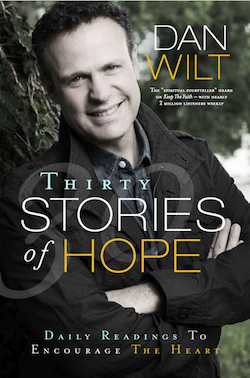 [Free Devotional Download "5 'Makes' of Great Relationships" from writer Dan Wilt- see at the bottom of the review.]
I've read a lot of books that deal with Christian topics, but many of them diverge into two camps:
A) theoretical advice that falls far afield from the reality of having to live here on earth, and
B) personal stories of victory and rescue that seem as foreign and contrived as movie fiction with no connection to what might actually help me.
What I love about Dan Wilt's book here is that he is our "everyman" talking about real life stories that meet you and I on the playing field of life, not some super-stardom miraculous happenings that never seem to happen to you and I. Dan talks about moms, dads, children, working, friends, struggles and real life- and shows the absolutely glorious rays of hope that shine into our lives from the source of true hope- God Himself. I won't share details of these stories because they are rich in their reading and well worth the individual time to digest one a day until you've filled up with the kind of life-giving inspiration Dan weaves with words. Dan's gift is story-telling, and judging from the 2 million listeners he speaks to each week, there is little doubt that his message is heard, loud and clear.
I've had plenty of tough times, personally, and the stories Dan tells are part of a diet of encouragement that our world is desperately in need of. And it's not just because they are clever stories. Rather, it is because the center of his hope-telling is the person of Jesus, in whom all Dan's stories source their glistening ray of light.
I love this book because I can read something reasonably sized for my busy day and just let it digest for 24 hours. Some times I feel like a story is good enough for a few days. But I like that the book is set up for busy people like me. The story is powerful but succinct. Each story has a theme, a real life application and a foundational scripture verse he ties things together with.
I can't recommend this book enough. Really, it is a great treasure.
Amazon Book Link: http://amzn.to/1fYNCut
Review by Kim Gentes
DOWNLOAD! Check it out below!
Be sure to chime in and let us know what you thought (post comments) and you are welcome to share this with friends on Facebook and twitter with your friends.
Free Devotional Download "5 Makes of Great Relationships" from author Dan Wilt
|
|
|
 book, chicken soup for the soul, christian, dan wilt, devotional, encouragement, hope, positive, review, story, story-telling, thirty stories in Allegory, Book Review, Community, Counsel, Devotion, Family, Grief, Healing, Jesus, Loss, Prayer, Reconciliation, Resurrection, Society, Theology
 Financial Peace Revisited - Dave Ramsey (2003)
Friday, October 4, 2013 at 10:52PM 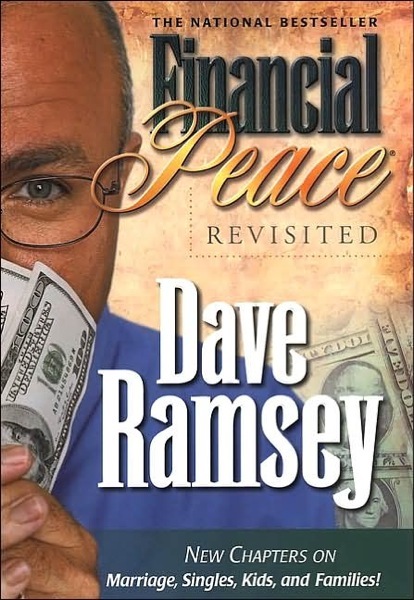 Personal finance books can sometimes sound about as exciting as an economic history textbook. But personal finance has a profound impact on the average person and family. Dave Ramsey is a radio show personality based in Nashville who has become successful as a speaker and author in the area of personal finance.
His first book, Financial Peace, has grown into a seminar, course and nationwide educational phenomenon having literally thousands of centers (mostly churches) that host the personal finance course called "Financial Peace University". The goal, as the title indicates, is to train people to gain peace in the area of finances.
In reading through this book, I started off with a fairly critical perspective. I am not the kind of person who likes listening to radio personalities that publicly berate callers on the topic of their “expertise”. I knew that Ramsey had a public persona of hard-nosed and I feared his book would be pompous and self-aggrandizing. I was wrong. “Financial Peace Revisited” is a pointed book, for sure, but it is tempered with the care of a person who has lived through real life. Some of the book relates Ramsey’s personal story of rags to riches to rags and back again- including growing a successful real estate business that crashed and burned, and his later recovery and learning process out of personal debt into long term financial “peace”. It is from this personal experience that Dave Ramsey tells not only his story, but the touch-stones of common sense that led him away from the common American family cycle of financial mismanagement.
In his book, Ramsey articulates compact truths that he calls “peace puppies” that are the foundational points of his thesis. One can’t say that the points are revelatory- but good advice rarely is. “Financial Peace” expounds the simple and clear truths of personal finance that many know, but few actually live. This is Ramsey’s main contention- we don’t live out the common sense items that would allow our money and careers to work for us. Instead, we allow the borrowing of money (normally to buy unneeded things) become the master and driver of our lives. It is this borrowing cycle that drives American personal finances into common and regular ruin.
Ramsey’s biggest and most salient point in this book is the belief that debt (all debt) is to be avoided and countered. There are plenty of other items, but they all serve to address this primary issue. But the brilliance of Ramsey’s approach is not just the common sense, but the emotional recovery of the debt-laden Americans who work Ramsey’s plan to come to financial peace. The biggest of the “smart moves” that fuel a “can-do” attitude in Ramsey’s followers is his recommendation that they pay the smallest bills first, and as those smaller bills get paid off the amounts used to pay those off get rolled cummulatively into the next largest bill. His “debt snowball” is genius, but almost counter-intuitive.
But it works. By paying off small bills first Ramsey knows that his customers will be feeling the emotional encouragement of seeing bills actually paid off. This heightens their awareness of the positive outcomes of their actions, giving them emotional fuel to continue paying off debt and working their recovery plan. In addition, the monetary power of those small debts being paid off cummulatively gets unleashed on larger and larger bills. Practically and mentally, the momentum is placed in the realm of those who follow his plan. In fact, he challenges people not to try to do too much too fast, for fear that this will only cause them to hit the emotional wall when the recovery from financial distress begins to drag on for many months and years.
There are literally dozens of great points in this book, and few errors. The only complaint I have with this book is its outdated, and somewhat unrealistic “positive” saving scenarios. In the book, Ramsey expounds that compound interest works powerfully against the consumers- and this is right. He says that if we save we can reverse this trend not only by not building up more debt (breaking the cycle of increasing debt) but we can use interest bearing savings options to let the money work for the consumer. But his oft-repeated examples are nowhere close to reality. The books cites, in a few examples, 8-12% return on compounding savings, which isn’t true in any consumer bank in America (and hasn't been in recent modern history). It isn’t true in money market funds and it is barely even true in mutual funds these days. There has never been an era lasting more than a year or two when most consumers could get a reasonable return on savings (especially when compared against inflation) without playing the stock market through mutual funds, but this is not how Ramsey says it. The point is, this detail could easily be updated and adjusted to reality to give the book more credibility- and it would be good if it were. To Ramsey's credit, he does get into details about how to invest later in the book, dealing with various investment vehicles that could give the reader the returns he talks about. Just a bit more differentiation between "savings" and investment I felt were needed for the scenarios presented in the first half of the book to make sense.
Beyond that, the book is very nice to read, quick to understand and support to those who actually want to “do it”!
One very nice feature is the regular end-of-chapter summaries by Sharon Ramsey (Dave’s wife) who takes a spousal perspective on how the main points of each chapter effected her life. This is a very nice contrast to the “go get it” approach of the author and gives the book some balance. Overall, this is a very good book, that contains not only great personal financial advice but seems to have proven itself worthy of the thousands of people who have taken Ramsey’s advice and gotten themselves out of financial struggles.
Amazon Link: http://amzn.to/17G2EiI
Review by Kim Gentes
book review, christian, counselor, dave ramsey, debt, finances, financial peace, money, personal finances, radio in Book Review, Business, Counsel, Economics, Family, Leadership, Society