Book Reviews (by Kim Gentes)
In the past, I would post only book reviews pertinent to worship, music in the local church, or general Christian leadership and discipleship. Recently, I've been studying many more general topics as well, such as history, economics and scientific thought, some of which end up as reviews here as well.
Entries in Book Review (90)
Debt: The First 5,000 Years - David Graeber (2011)
 Friday, February 1, 2013 at 11:38AM
 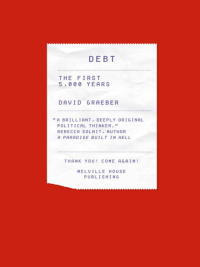 In the last four years I have read many thousands of pages of materials in researching an understanding of economics, history and culture. In that time I have read little that was as well-written and insightful as David Graeber's "Debt: the First 5,000 Years".
What initially holds Graeber's work above others is his contrarianism related to the foundations of Adam Smith's capitalism, especially the historical telling of barter as the nascent form of exchange that led eventually to our current modern version of free market capitalism. The author makes the point that debt, rather than barter and money, was the foundational language and system of exchange and has remained so for 5,000 years. The book claims that Smith's story related to the origins of markets, as found within "The Wealth of Nations", is a contrived fiction in which barter is used as the seed explanation for how currency/money/economy developed.
The grander plot of the book is that reciprocation can expose itself in two primary ways - owing a favor, or owing a debt. As he says poignantly-
the difference between owing someone a favor, and owing someone a debt, is that the amount of a debt can be precisely calculated.1
The book starts off with a modern day controversy about global (specifically, third world) debt. The question is raised about whether paying back debt is a moral question. From this launching point, the author traces back, through his anthropological background, five millennia of understanding human societies and how their systems of debt have become the framework for our understanding and conversations about virtually every aspect of life, especially (and including) morality. Graeber states-
If one looks at the history of debt, then, what one discovers first of all is profound moral confusion. Its most obvious manifestation is that most everywhere, one finds that the majority of human beings hold simultaneously that (1) paying back money one has borrowed is a simple matter of morality, and (2) anyone in the habit of lending money is evil.2
Part of the reason that morality and debt are so closely and importantly linked for the author is that he goes to great lengths to connect the idea that the moral failure surrounding debt is not with the debtor (as current culture suggests) but the with creditor. Graeber makes this important distinction not purely on the present circumstance (in which one person places themselves in debt to another as part of an exchange), but uses historical and anthropological examples (and theory) to expose the fact that for thousands of years debt has been enforced by the most heinous means- from debt peonage, slavery, prostitution, imprisonment, war, violence and more. At the root of the human ability to harm and debase one another over a debt is the fact that debts devalue not just the items exchange, but the very people themselves.
From this perspective, the crucial factor, and a topic that will be explored at length in these pages, is money’s capacity to turn morality into a matter of impersonal arithmetic—and by doing so, to justify things that would otherwise seem outrageous or obscene...3
...The way violence, or the threat of violence, turns human relations into mathematics will crop up again and again over the course of this book.4
The book develops a long and complicated understanding of various ages of exchange in which society went from credit based exchange to coin/currency exchange and back and forth for various reasons. Graeber's work is compelling if not confusing. While he is obviously a brilliant researcher and thinker, he languishes several times in the book to keep himself on task to his earlier promises. Many points that look to be big items drift off aimlessly into side issues and what seems like favorite quotes from the authors research work rather than essential points to the thesis. One of Graeber's important points about exchange/market systems is that they are integrated tightly with government constructs of debt and war.
modern money is based on government debt, and that governments borrow money in order to finance wars.5
All of this actually does matter in his final thinking, but he mars the straight lines of thought by randomly attacking capitalist thinkers like Milton Friedman and Adam Smith because he doesn't like that they said things built on utopian models (though he admits that what they said ended up being true and actually working in the real world). Graeber is right in one sense- it matters why society thinks the way they do, and how ideas that changed history came into being. But while he is proving his points he meanders unsuccessfully through some issues by pretending that his ability to invert the predicate logic of a phrase (i.e. "what does society owe us?" into "What do we owe society") is appropriately addressing the real issue. But in the end, his book is much better than the faults he makes in crafting his narrative- because he asks some great questions.
The biggest of these is about the nature of exchange and the nature of value. At the core failure of humanity in relationship to debt is a devaluing not of goods, but of the human person itself. Graeber is at his best when he challenges us to recognize that our history and our current practices have run rampant not because we use one economic system or another (capitalism or such), but because we allow the exchange system to carry us too far -- we allow it to exchange human life for goods. In essence, our systems of debt exchange place a value on human life as a way of equating what can be paid back when the currency is not. This happens in slavery, debt peonage, debtors prisons, and even wage labor. It is ultimately a very compelling point, since he basis it on solid history and plenty of modern examples.
Some may decry this book as anti-capitalist, but I think Graeber is reaching for a higher ideal than that. I think he is looking for valuing human life right on forward to the present. That we provide protection for wage laborers, abolish debt peonage systems (that still exist in some countries today), even human slavery and worse. He is also advocating the questioning of some systems that were built on these premise and have become unchallenged (such as new NGO loan systems, World Bank and the IMF), leaving whole nations in essentially debt servitude to multi-national corporations and countries such as the US.
Though he says these things, Graeber is not a raving anti-capitalist. His book is well worth reading. It sparks of brilliance in places and requires serious thought. The corruption of the value of human life has been enmeshed into the exchange of the marketplace, and for Graeber this must be untangled if we are to make better decisions for the future. For this, he deserves huge praise and an honest reading of the material.
Amazon Book Link: http://amzn.to/WZkw0w
Review by Kim Gentes
1. Graeber, David (2011-07-12). Debt: The First 5,000 Years (Kindle Location 8120). Random House Inc Clients. Kindle Edition.
2. Ibid., Kindle Locations 202-204
3. Ibid., Kindle Locations 310-312
4. Ibid., Kindle Locations 320-321
5. Ibid., Kindle Locations 7694-7695
Crazy Love - Francis Chan (2008)
Thursday, January 24, 2013 at 11:43PM  What is the distinct thing that makes the Christian life different from any other? Francis Chan's book "Crazy Love" is a short and clear call to exploring that distinction. Chan is convinced that our lives must be founded and fueled by love. Then, on the basis of that love, we are to sacrificially give away our lives as the "way" to be the people Jesus called us to be.
For the first few chapters Chan explores the motives of our "service" (acts and lives lived) as Christians. Such things as fear, pride and various other substitutes are proved to be false foundations in place of a thankful life that exists in light of a truly awesome and holy God. Chan urges us to see God as the scriptural Everything from, and to which, true love can proceed.
In light of the God of "Crazy Love", the book moves the reader into a realization of the biblical view of a response to such a God- a response that can only be real if it sees action. But Chan is not preaching the "American god" of prosperity in his book. Rather than a god in whom we strive to achieve success and are granted blessings of favor, position or possessions- Chan is calling us to lay down everything. At the root of "Crazy Love" is a deft prescription to the American church- sacrifice.
Often times, when books are written that call Christians to humility or sacrifice they do so from a position of making people "worms" in light of God's all-consuming awesomeness. Conversely, much of Christian "faith" culture has made the American god one of "success"- basically teaching that if we are following God's plan for our lives, blessings and abundance will be ours to receive and accumulate.
Chan avoids both of those clichés and calls us to see the God of "Crazy Love" as the source and strength of all we can be. From that place of trust and faithfulness in God's love, we are to offer our lives sacrificially as conduits to bring that love to the hurting and lost world. There are a good many insights in this book, but Francis doesn't turn this insightful teaching into just another cliché itself. If you stopped short of finishing the book, you might believe that you should sell everything you have, move to Africa and feed the destitute. While Chan poses that as one path for those called, he doesn't fall into the trap of becoming the voice of the Holy Spirit for the reader. Instead, he presents his thesis as a starting point from which any believer can then step into the world of possibilities that only God can uniquely chose for each one of us.
One may minister to the poor, another serve as a medical missionary, another stay in their current careers and show God's love there. The point is, the book asks the reader to be accountable to God and the voice of the Holy Spirit. After the book has explained why Christians should lay down the edifice of the American ideal "life, liberty and the pursuit of happiness" (which we often translate into being the selfish accumulation of "stuff") it encourages the believer to follow God's direction specific to their lives.
The message of this book is clear, simple and yet often ignored. I was convicted by the simple truths of this book. I would guess my experience is not alone. The book presents a vivid picture of a different kind of Christian- the kind we are in dire need of in our world.
Amazon Book Link: http://amzn.to/WjPvX3
Review by Kim Gentes
crazy love, direction, discipleship, fear, francis chan, giving, love, obedience, poor, sacrifice in Bible, Book Review, Church, Community, Family, Jesus, Justice, Leadership, Ministry, Mission, Postmodern, Prayer, Society, Theology Collapse: How Societies Choose To Fail or Succeed - Jared Diamond (2005)
Monday, January 21, 2013 at 1:38AM 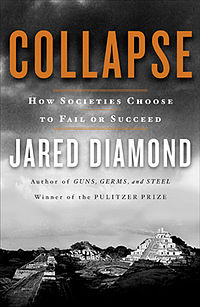 After reading "Guns, Germs and Steel" by Jared Diamond, I was interested in getting a hold of his companion book that inverted his focus on study of societies. "Guns, Germs and Steel" was the definitive analysis of what precipitated the rise of humanity as the pre-eminent species on earth and the rise of western society, specifically as the pervasive and expanding culture among all those of mankind in the modern era. From the cover, Diamond's "Collapse: How Societies Choose to Fail or Succeed" looks to be an investigation into the corrupted, extinguished and collapsed cultures of our human history- and an equally astute examination into the causes of such collapse.
But like Diamond did with the title of his Pulitzer Prize Winning book ("Guns, Germs and Steel" was far more about food production via agriculture and animal husbandry than it was about the items in its title), "Collapse" is a deceptive moniker for the content of this book. It is not incorrect, but perhaps not accurate or detailed enough. Collapse is not about how any, or even most, societies collapse- it is specifically about how a select set of societies collapsed under the specific cause of man-made environmental damage that leads to devastating self-destruction of the entire population of people involved. Focusing on human environmental self-destruction only, the book doesn't talk about why the great societies of the Romans, Greeks, Babylonians, Mongols, Egyptians, Imperial England, and dozens of other well known historical successful societies eventually toppled. Instead the focus is on a set of specific (and often extremely small) nation states that self-destructed by environment ill-management of their land and food sources.
The reason I bring this up immediately about the book and its title is because it is such a significant contrast to "Guns, Germs and Steel", which covers almost the entire gambit of ancient, medieval and modern societies that proved successful and managed longevity. Diamond is not writing a companion book with "Collapse". Instead he is narrowing his focus to his true area of expertise- biological. It is from that perspective that Diamond does drill deeply into the backstory, progression and decay of societies that destroyed their own home environment so significantly that the ecosystem which supported their existence (in its destruction and barrenness) becomes the cause of their demise.
The author examines a number of island societies to explain their self-destruction. As it turns out, the fragile balance of an island ecosystem supporting a smaller nation of people's is most easily in jeopardy and hence gives us the most evidence to such collapses. From Easter Island, to Pitcairn and Henderson Isands, to the Haitian and even the large island of Greenland- each of these places are isolated and independent, having no careful management of their natural resources as food sources.
But beyond the island setting, Diamond also reviews such situations as the terrible genocide of Rwanda (for which he provides a broader explanation than just racial/religious hatred as the fuel of that ravaging atrocity), the growing environmental damage by China, the tragic effects of mining without environmental care in Australia (and the US), and even the good/bad examples of resource/land managements by modern corporations hunting for resources (from Chevron to Pegasus Gold to DuPonte and more).
The author outlines (in summary chapters) the progression of damaging processing that causes deforestation, mining damage, top-soil erosion, water flow mismanagement, overgrazing, over fishing and over harvesting of resources, minerals and food sources. He explains how these components can eventual lead to devastation and possibility of a societal collapse. The book is hopeful that our environmental self-concern and technological inventiveness can help us find solutions to these problems, near and long term.
I found Diamond's arguments and reasoning to be easy to follow, yet insightful. While this wasn't the book I hoped it would be (as I stated before), I did appreciate the writing and content. Diamond is not a died-in-the-wool environmental radical. He debunks the extreme positions of environmental apocalyptics and provides good as well as bad cases of even corporate environmental citizenship. His positions are based on science and research of this topic for decades. As you read, you feel like you are getting sage advice and not indoctrination. The book doesn't have nearly as many epiphanal moments as "Guns, Germs and Steel" for this reader, but I found it good nonetheless.
Amazon Book Link: http://amzn.to/WQHRzM
As with Diamond's other work mentioned here, if you like detailed reading with high-order concepts, I highly recommend this book.
Review by Kim Gentes
50 Economics Ideas You Really Need to Know - Edmund Conway (2009)
Thursday, January 17, 2013 at 1:44PM 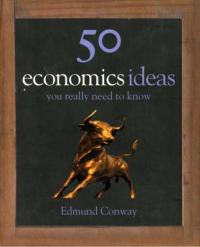 If you are trying to learn about economics there are a few different approaches you can take. First, you can study the classic documents, such as "The Wealth of Nations" (Adam Smith), "The General Theory" (J M Keynes), "The Road to Serfdom" (Hayek), "the Communist Manifesto" (Marx) and a few other seminal texts to gain an understanding of how the modern economic stream of study progressed in the last 3 centuries perhaps right up to current works from Friedman and even Laffer. But that approach is arduous and frankly too technical for most people to care to enage with. The second route is to take a college series of courses, which may run through these same ideas in summary by using texts such as survey books like "The Making of Modern Economics" (Mark Skousen) or other general survey books. But this second route maybe not provide a balanced outlook of the differing perspectives, since professors and writers of individual texts are prone to present support for their own beliefs rather than give a neutral view. The last route left for those of us who aren't trained economists is to read simpler books, written for the public.
In that vein, one of the best books I've come across is simply titled "50 Economic Ideas You Really Need To Know". Author Edmund Conway has written a cogent and actually cohesive book that is less disjointed than the title might imply. Beginning with Adam Smith's "invisible hand" doctrine, exploring supply and demand, the Malthusian trap and opportunity cost, Conway guides the reader quickly and clearly through fifty (yes 50!) of the key concepts in economics. After having read several other books (from many of the 3 different approaches I mention above) on economics I found this layman's guide to not only be remarkably accurate and well written but well organized. Economics is often said to be a study of people and their uses of resources, including the decisions they make regarding those resources. Conway starts this book with a more pointed view saying -
Economics examines what drives human beings to do what they do, and looks at how they react when faced with difficulties or success.1
This turns out to be an excellent primer to understand how this book is approached and presented. Starting with the basic core of Smith's economic theory, the author moves from basic numerical balances (such as supply/demand) through philosophical ideas (such as communism, keynesianism, individualism) to measurements of economies (such as money, taxes, debt, unemployments) to finances and markets (such as stocks, bonds, credit markets etc) and finally to modern issues (such as creative destruction, global deficits, protectionism, technological revolutions). Each of these are readable as separate items (great if you need to learn about money markets or pensions without wading through an entire book), but Conway has blended the topics so well that the text is built into an excellent progression if you have the time to sit down and read the short 200 page book in a sitting or two.
For now, this is the best layman's summary book on economics that I have found. If you want a crash course- this is it. It's clear, concise, and takes great many pains not to be a partisan supporter of whatever school the author might have an affinity for. In fact, most economics books bleed their prejudices so clearly it is often obvious whether the writer is a proponent of Keynesian, Austrian, Friedman or any of the other streams of economic theory. Here, the theories are all presented and none derided. The pros and cons are pointed out for each. For this alone, I consider this short layman's guide to be solid gold, and far better than 90% of the detailed economic survey books available (which almost always take philosophical sides).
If you are looking for a one-book-fits-all, short summary of economics to get through in a day or so-- look no further than "50 Economic Ideas..." I can't give this book any higher praise than my unequivocal recommendation!
Amazon Link: http://amzn.to/V8Dpy8
Review by Kim Gentes
1. Conway, Edmund (2009-09-03). 50 Economics Ideas You Really Need to Know (50 Ideas) (p. 3). Quercus. Kindle Edition.
The Writing Life - Annie Dillard (1989)
Tuesday, January 15, 2013 at 10:25AM 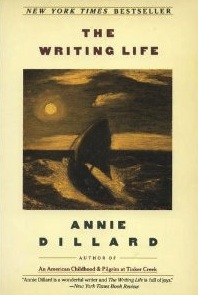 Of late, I have been reading more books on, ironically, writing. A friend recommended one to me which I hadn't heard of. It was Annie Dillard's "The Writing Life". As I began it, I was warmed by her whimsical style and insightful prose. But soon enough, I was getting hungry for the "meat" of a writer "advice" book. Then it hit me. Her device to teach the writing life was to example it, not dictate its proofs in three-point style.
I am a simple kind of thinker in this regard, as my natural tendency is to take everyone at their word. She had titled the book "The Writing Life", and I thus assumed she would explain it in the book. I wouldn't have expected her to live it. But this is what Annie Dillard does. She explores with narrative prose the way her own life has been fashioned by its conversations, moments, people and events. She arranges those as elements of a real story- her story- and allows you to look in and see if it reflects something of the human soul which can ignite your own writing life. And it does.
Don't get me wrong, there are plenty of points that could fill a "tips and thoughts for aspiring writers" textbook, and they are distributed liberally throughout the pages of this work. But Dillard knows that they way the stick to us is to pair them with our hearts through her own well written words. The first of such moments for me happened when I was almost fumbling through the early chapters and one of those word-sculpted moments hit me square across the mind-
There is no shortage of good days. It is good lives that are hard to come by. A life of good days lived in the senses is not enough. The life of sensation is the life of greed; it requires more and more. The life of the spirit requires less and less; time is ample and its passage sweet. Who would call a day spent reading a good day? But a life spent reading—that is a good life.1
Write as if you were dying. At the same time, assume you write for an audience consisting solely of terminal patients. That is, after all, the case. What would you begin writing if you knew you would die soon? What could you say to a dying person that would not enrage by its triviality?2
A well-known writer got collared by a university student who asked, “Do you think I could be a writer?” “Well,” the writer said, “I don’t know…. Do you like sentences?” The writer could see the student’s amazement. Sentences? Do I like sentences? I am twenty years old and do I like sentences? If he had liked sentences, of course, he could begin, like a joyful painter I knew. I asked him how he came to be a painter. He said, “I liked the smell of the paint.”3
You will get several points of importance for understanding "The Writing Life" in this book, but along the way Dillard seems more concerned that you actually live and experience it than recite a formula for its vocational success. A thoughtful, uplighting and good book.
Amazon Link: http://amzn.to/10x9sxP
Review by Kim Gentes
1. Dillard, Annie (2009-10-13). The Writing Life (pp. 32-33). Harper Perennial. Kindle Edition.
2. Ibid., p. 68
3. Ibid., p. 70
annie dillard, author, books, creative techniques, dillard, inspiration, review, the writing life, writing in Art, Book Review, Literature, Resource, Writing