New Stuff

Book Reviews (by Kim Gentes)

In the past, I would post only book reviews pertinent to worship, music in the local church, or general Christian leadership and discipleship. Recently, I've been studying many more general topics as well, such as history, economics and scientific thought, some of which end up as reviews here as well.

Entries in Book Review (90)

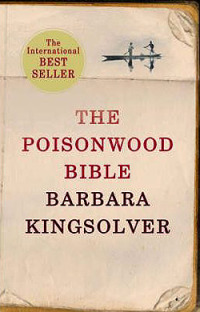
The Poisonwood Bible - Barbara Kingsolver (1999)

Reading a novel set in a real world circumstance, one can forget that the story is nonetheless fictitious. And this might just be what Barbara Kingsolver intended on happening in her novel "The Poisonwood Bible". The story is a wonderful and complex character study set in the exotic land of Congo in the late 1950's and extending until the 80's (where the book storyline ends). The book explores injustice at various levels but most poignantly as it occurs from the emulated figure of Nathan Price- who represents the kind of personal, painful, domestic and religious antagonist that we both hate and pity. Kingsolver is intent on demonising the Baptist missionary as preacher, husband, father and human being with a subordinate purpose of political preaching on the part of the author.  Don't get me wrong, I found the book to be very well written and very accurate of some Christian leaders across history. The arrogance and insensitivity portrayed through Nathan Price typifies what most Christians (let alone people) despise about religion- that within it's ranks are voices more harmful than healing.

But the author fails to place a voice of reason within the scope of the story that can represent the missionary vocation as anything good. The other missionaries explored in the story are either white snobs who profit and exploit the country and its riches or protestants who convert to Catholicism in the course of their mission. Kingsolver does not give us a realistic contrast to Nathan's evil and we are left with a darkness that reveals truth but grows to expose the author's own prejudices. We can believe a man can be as arrogant and unkind as Nathan Price, and that his family can survive (at least partially) from his influence- but we are left feeling like the story was artificially built against the man rather than just naturally revealed as part of the narrative.

That said, "The Poisonwood Bible" is excellent writing with vivid characters, undulating dialog that feels absolutely real, exotic settings to be explored and real life, joy and pain to be experienced. Kingsolver is brilliant as a novelist, making situations feel like real motion. And when things are interrupted, by pain, joy or surprise, the reader is given space to feel the experience through her vivid prose. One chapter especially had me nearly in tears- as a young child dies and a painful, haunting day as lived by the family members is recounted.

This novel is a story, but it is a good story and it does teach us something of moral value. The lesson are not contrived, even if the platform is occasionally stolen for political stumping about American imperialism and European colonialism. The life and gift of this work is its characters, its setting and its revelation about human character in its strain to indoctrinate others into a system of belief.  The author uses multiple points of view to tell the story- a mother and her four children are the voices of this prose. The father (our antagonist) is never given his own voice.  As a man, I think this was a wise choice of the author- since it allows the reader to interpret the mind of Nathan Price simply by his speech and actions. And it is this kind of judgment that his family members must make about him as well- and they do.

This is a very good novel by an exceptional writer- if you like character built stories, this is a good choice.


Amazon Link: http://amzn.to/VZkGo7


Review by Kim Gentes


Do The Work - Steven Pressfield (2011)

After reading Steven Pressfield's "The War of Art", I jumped at the get-it-done companion called "Do The Work".

There are two reactions to it that must be clear. First, if you are a technical person who is not a natural creative- this book is perfect for you. Second, if you are a natural creative who has too many ideas and not enough completed projects- this book is also for you. The problem is, you must digest it with the right understanding of who you truly are. Let me explain.

Pressfield's approach is attuned mostly to technical people who don't trust their creative juices. This group of people understands the nuances of self-criticism, evaluation, re-writing and more. What they struggle with is that they over-analyze and over-prepare so much, they become weighed down by the weight of this mind-heavy preparation and either never start the project in earnest or become crushed under their self-criticism. Pressfield has excellent advice that will allow those people to properly set aside self-critism to a proper time in the process. The goal for them is to get them moving and trusting the creative process and ideas in them.

For the truly creative person with little ability to filter and less ethic to complete a project, "Do The Work" lays out a plan that they can take advantage of their creative juices but put meat on the bones before the next wind blows in and grabs the creative's attention away from their current work.  For those people- read the book, and do the work. Follow the instructions and channel the inspiration as told by the author.

The problem with this book is that the technical or creative person may well misunderstand who they are and not approach this kind of advice properly. The book is solid, but it doesn't help the reader distinguish how to navigate their absorption of the material. Hence, I see several reviews of this book from what I call "high technicians" (people who aren't true creatives) who criticise the book for encouraging people to follow their instincts. But true creatives should ignore those reviews. This book is easily interpretted for true creatives and they can take the writer at face value and follow instructions as stated. For technicians (who often erroneously think they are creatives), you should realize that you will automatically have the tools of self-criticism and correction that will allow you to make the detail and methodical adjustments that every project needs in the revision phase- don't misinterpret Pressfield's guidance to let the inspiration "flow" in the beginning of the creative cycle sound like "throw caution to the wind" for the entire process. A proper reading of hte book and self-awareness and sel-understanding will make this clear.

Personally, I came away with 2 excellent and helpful tips from the book. Important things that I will never forget and have already begun to use.  Because Pressfield assumes that deeply creative people will be the users of his book, he doesn't take time to nuance how the book should be approached. I felt this might help some of those who were coming at "Do The Work" from a couple different vantage points.

In light of that, it's a very good book and I highly recommend it. 


Amazon Book Link: http://amzn.to/Wbs0M0


Review by Kim Gentes


The History of the Decline and Fall of the Roman Empire - Edward Gibbon (1776)

Defining an era has come to be the popular work of historians who have had the fortune to write well enough to have appeal to the general public. The work of research, selection, collation, evaluation and summation on a given time and subject seems daunting enough. But imagine for a moment that you were tasked with writing a comprehensive book on a subject that covered about 1500 years of time and included most of the known world. This is the kind of work that was tackled by Edward Gibbon in writing his multi-volume tome, “The History of the Decline and Fall of the Roman Empire”.

Before we begin to appreciate the topic and contents of the book, we must recognize the unbelievable accomplishment of Gibbon. The sheer amount of content, volume of research and power of mind needed to accomplish this task is nothing short of legendary. And the impact resulting from this work has been no less impressive. Published in 1776, its appearance in the same year as two of the most important documents in modern history, The Wealth of Nations (by Adam Smith) and the American Declaration of Independence, is not subservient in weight to these other works. What these documents meant to the immediacy of political and economic changes in the 18th century and beyond, Gibbon’s work has meant to academicians, historians and scholars who received in “The History of the Decline and Fall of the Roman Empire” the seminal account of European (and world) history for the time period of 2nd to 14th century AD.

Exploring a summary of the details of this book is literally impossible in less than 20-30 page report for even the scantest of overviews. The Roman Empire, according to Gibbon, reached reached its apex power and stability within the purview of the reign of Augustus Caesar and was subsequently managed with intrepidity under the stewardship of Nerva, Trajan, Hadrian and the two Antonines. The end of that era marked the conclusion of the Roman majestic glory, after which the fruit, growth and full harvest of corruption impaled the Empire with repeated thrusts of political, economic, military and societal failure. The Roman empire expired not in one cataclysmic event, but in a gradual failure of systems and life highlighted by poignant defeats throughout its structure. Indeed, according to Gibbon, it was the weight, success and vastness of this magnificent empire that ultimately pulled its components and leadership down on top of itself.

Gibbon’s articulation of the facts and illumination of the forces behind those facts builds this book into an epic not only of history but of the genius of this author's mind as a great tool of systems analysis.  The writing is so methodical, it takes on a rhythm in each progression of reign from emperors to dynasties to epochs. The reader is given a clear (even if daunting at times) assessment of each and every ruler of the Roman legacy. This is as one would expect. But what one would not expect is the deep and penetrating review of literally every other force at work throughout the known world during the long tenure of the Roman world. From Atilla the Hun to Mohammed (the growth of Islam) to Genghis Khan to the long and arduous story of the Christian religion to the history of each of the barbarian nations and tribes to the dozens of tribes and rulers of the Arab, Scandinavian, Germanic, African and even Mongol streams. Every single influence that made its presence felt in the Roman world is examined, with elaborate prose, via the pen of Edward Gibbon.

The writing is obviously scholarly, yet is very readable in our current English form. While it is rife with detail it is also pithy and even humorous at times. The only vise which Gibbon displays with regularity is his almost insistent propensity to present his points in threefold form. It seems like every section or detail was listed with a triplicate procession of reasons, even when it might have just been a habit that Gibbon filled with his illustrious prose rather than the succinct clarity of solid data. Gibbon also spends regular opportunity to berate the prejudices of various other historians of antiquity and the subjects of his own writing- although reading his book 250 years later, his own prejudices shine through as clearly as those he occasionally demonizes. It will always be the vice of every writer to misunderstand the worldview within which their own work was undertaken, and Gibbon does not escape from this truism. However, he does seem to be aware of this possibility and rains or shines on the variously good/bad qualities of any given subject where it was clearly needed.

It is from the story of Roman power and descent that we see the pre-eminent example of the idiom "power corrupts and absolute power corrupts absolutely". The dozens of leaders and pretenders that rise and attempt the imperial purple of Roman emperorship turn into a mind-numbing repetition of ascent to prominence, coup of the current emperor, rise of power for the new, corruption and decline into another regime toppled by murderous treachery.  This cycle is so certain that it becomes the only surety in the Roman story during its decline. Yet, there are heroes- people whose noble character rises above a desire for power. And those great characters break the mantra of power and corruption. It is in that contrast that we can glimpse moments of greatness. In the Roman story there is a reflective narrative of our human condition- one that has tragedy and glory. It is within this meta-narrative that we can glean greatness- and Gibbon is an excellent narrator.

What you have in “The History of the Decline and Fall of the Roman Empire” is a complete and unrelenting archive of over a millennia of history of the greatest geopolitical entity that has ever existed on the earth.  It is written in strident prose and breathtaking detail. Included in the footnotes and commentary of the book is much about the various historical research that has been done since Gibbon’s work. While some small parts of the book's data are now recognized as misinformed, the vast majority of it stands not only as a great resource but as the seminal text of the Roman epic.

You may well have many reasons to avoid reading this book, including perhaps its size of over 3500 pages (depending on the version you are reading). But none of those reasons are worthy of stopping the thoughtful person from reading, understanding and gleaning the wisdom of this tremendous book.


Amazon Book Link: http://amzn.to/TqJLs7


Review by Kim Gentes


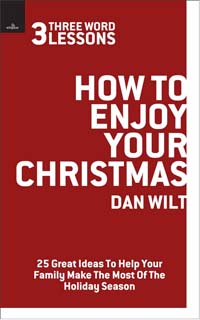
How To Enjoy Your Christmas (3 Word Lessons) - 25 Great Ideas - Dan Wilt (2012)

I am reading a lot more lately. And I have found there are a some topic-specific books that really are great! One such book I have just finished reading is called "How To Enjoy Your Christmas (3 Word Lessons)".

The idea of the book is summed up nicely in the sub-title:

"25 Great Ideas To Help Your Family Make The Most Of The Holiday Season" 


What I loved about it is the clear, smart and actually usable ideas I got from it. After over 20 years of Christmas's as a parent, I was running out of fresh ways to think about the season, without becoming weary. Author Dan Wilt reflects on how you can not only freshen the experience, but deepen your family and devotional aspects of a worshipful Christmas!

Everything from enjoying the fun, singing the music, devoting your heart, engaging through Advent, surprising those you love- Wilt gives you punch points to do, not just ideas to think about!

I love this little Kindle eBook, and at 99cents, I can't believe anyone else wouldn't either! Really, check this out- you'll love it!

I know you will enjoy "How To Enjoy Your Christmas" - eBook!


Amazon Book Link: http://amzn.to/UfMnGi


Review by Kim Gentes


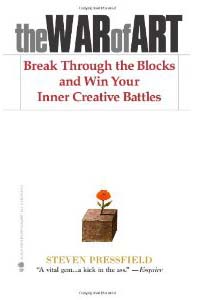
The War of Art - Steven Pressfield (2002)

I don't like motivational junk.  I call it crap.  When people try to sell me their wares as a way of "encouraging" me in some way it just doesn't sit right with me. For that reason, you have to understand that I would never in a million years have purposely went to buy this book. I thought I was buying a book about being a writer and some "tricks of the trade". But about 10 pages into it, I realized I'd been duped. I was kinda upset. (Keep reading! I was missing the point!) But since I had already bought it and simply wanted to put it away, I figured I'd better get through it.

That was the last point at which I didn't like the book. In about 2 more pages (and for the rest of the book), I got my butt kicked. Author Steven Pressfield talks as a creative person to other creatives, and tackles just one topic- resistance. This is the singular name that Pressfield gives to the demon that haunts every person who ever tried to do anything beyond themselves- in art, science, culture, business and life. Pressfield defines, explores, warns and outright swears at the demon of resistance. Pressfield is ticked off, and he wants his reader to join him- not in a soppy emotional healing time, but in an outright strategy of war against the only enemy likely to stop you from creating your unique art: your own internal resistance.

I've heard these concepts before in different ways, but they've never struck home as well as they have here. "The War of Art" is not only sharp and pointed, it is blissful and witty. It examples its content by explaining how the author himself got passed resistance to even write the book. It's not cute, but it is effective, and funny, too!

If you hate motivational speeches and don't want to waste money on feel-good crap, this book is the best thing for creatives since their mom slapped them up the side of the head and said "do your homework".

The book is short (just 190 pages) and it is written directly to authors, painters, musicians, creatives, entrepreneurs, inventors and anyone who is trying to start something (anything) of value that is significantly challenging.  This book is written from an artist/writer's perspective specifically, not of the Christian "self-help" variety, and if you are easily offended by occasional swear words, you may find this book hits you with occasional bursts of Pressfield's verbal punches.

That said, it's a great book and I very highly recommend it. 


Amazon Book Link: http://amzn.to/Simc47


Review by Kim Gentes