abuse,
bell,
betrayal,
book,
christian,
church,
clergy,
counseling,
grenz,
minister,
pastoral care,
sexual misconduct in
Book Review In the past, I would post only book reviews pertinent to worship, music in the local church, or general Christian leadership and discipleship. Recently, I've been studying many more general topics as well, such as history, economics and scientific thought, some of which end up as reviews here as well.
Saturday, April 2, 2011 at 9:45AM
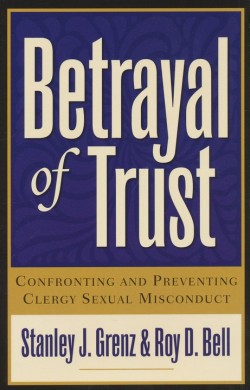
Clergy sexual misconduct is a complex topic. Attempting to identify, prevent and even confront it is even more arduous. In their book, “Betrayal of Trust: Confronting and Preventing Clergy Sexual Misconduct”, Stanley Grenz and Roy Bell attempt to tackle the gambit of definition, identification, prevention and confrontation of this topic, and they succeed. Grenz and Bell take a decidedly clinical approach to the book, rather than primarily a theological or pastoral vantage point (they do deal with the issue as it relates to pastors and their church communities, but most insight, sources, support and direction comes from the clinical arena). This gives the text credence to the professional therapeutic community, as well as the clergy world. While the book clearly articulates ethical implications of clergy sexual misconduct, it also investigates the far reaching effects on all parties involved- the victims, the pastor-offender, the pastor family, the local church congregation and even the broader representation of the pastoral offender as they stand as a representative Christ to the world/broader community.
For me, the most profound contribution of the book was to show (through numerous examples) that the definition of sexual misconduct is centered in the power granted (and used) by the offender via their position, status or trust in the local church community. It is, then, from this position of power that misconduct is carried out, both because of its ability for the man in power to compel an opportunity for the woman to receive his advances and for the further use of that power to enforce an atmosphere of silence. Quoting psychologist Peter Rutter, the entire book is hinged on this specifically defined understand of sexual misconduct:
“any behavior by a man in power within what I define as the forbidden zone is inherently exploitive[sp] of a woman’s trust.”[1]
and
“sexual conduct between men in power and women under their care.”[2]
This definition of sexual misconduct as being rooted in a man’s position of power is crucial to identifying, preventing and challenging the behavior, as the author’s demonstrate by numerous examples. The first chapter of the book begins with explaining the extent to which misconduct has spread through all denominations and spheres of the Christian church. After that, the chapter identifies the scope of the problem across a range of spheres which such misconduct will impact- the pastor, the family, the church, the victim, and the gospel itself.
The second chapter explores the categorizations and situations in which a pastor can be “at risk” for sexual misconduct. Chapters three and four explore the definitions and implications to which sexual misconduct is a betrayal of the trust and a misuse of power on the part of the offender. In this section, the authors essentially place all responsibility for sexual misconduct between a minister and a congregant firmly on the shoulders of the minister. They quote Marie Fortune (which concurs with several other cited sources) by saying succinctly:
“it is the man’s responsibility, no matter what the level of provocation or apparent consent by the woman, to assure that sexual behavior does not take place.”[3]
Through a series of layered, logical arguments about power, authority and trust, the authors establish that the above is not only true, but is almost exclusively a male problem.[4] While not stating that it is inherently a male causation at work in the issue, the problem is due to the inequities of positions of power (both clergy and otherwise) being so dominated by men. Since power is at the base of the problem, people in power are the source of the misconduct.
The book goes on to make several helpful observations about how to minister to various groups of victims, recommendations and methodologies for prevention of misconduct, and even church response and possible guidelines for (church) governmental policies that may be helpful. All these items seem helpful.
One other very helpful point made by the book comes in the form of a listing of three proto-typical offenders of sexual misconduct: the predator, the wanderer, and the lover. While the stereotypes aren’t perfect, they articulate well the kind of people who may offend and what options we can consider in dealing with them. Most poignantly, the wanderer seems to be potentially the most effective area to focus our efforts at prevention and restoration. This is a helpful way to think about the issue, since it seems a fairly even-handed and thoughtful evaluation of what kinds of people may offend the privilege of the clergy position, for what reasons they might do so and how they might be equipped to avoid such offence.
That said, there were parts of the book that didn't seem complete or evenhanded. While understanding that clergy power certainly holds sway over congregants, there were three areas that intend power over a local church that are poised for the possibility of misconduct, but are not dealt with in this book. Other positions of possible misconduct are: spouse of minister, church boards and their members, and influential patrons of the local church. Each of these positions hold possible power in local churches, none of which was dealt with in the book. I see that as a weakness of an otherwise excellent book.
That said, the majority of the book is insightful, compelling and helpful for churches and ministers. The oversights I have mentioned would have improved the book, but ultimately didn't deter from the book's effectiveness in the areas it attended to. For people with roles as pastoral leaders in church team, the most helpful thing to be learned from this book was the relationship of position/power to the potentiality of misconduct- that the minister is inherently endued with control in relationship to a congregant vis-à-vis the locus of power attendant to their position. Along with this control comes the corresponding responsibility for any and all actions of sexual misconduct between pastor to congregant.
Book Product link: Betrayal of Trust: Confronting and Preventing Clergy Sexual Misconduct
Review by
Kim Gentes
[1] Stanley J. Grenz & Roy D. Bell, “Betrayal of Trust: confronting and preventing clergy sexual misconduct”, (Grand Rapids, MI: Baker Books 2001), Pg 17
[2] Ibid., Pg 17
[3] Ibid., Pg 94
[4] Ibid., Pg 17,19
abuse,
bell,
betrayal,
book,
christian,
church,
clergy,
counseling,
grenz,
minister,
pastoral care,
sexual misconduct in
Book Review
Friday, April 1, 2011 at 3:05PM
What would happen if a successful, self-assured young pastor of a metro-mega church faced up to the crushing reality of pain and doubt that plagues so many of his congregants? Even more, what would happen if he began to experience his own self-awareness, and started to verbalize it to his congregation? Would he lead his church through a time of learning and growing through the process? Or, would they reject him and move on to someone who would resound with surety and triumphalism, assuaging the congregants that "all is well" in the spiritual headquarters of their local church?
Ian Morgan Cron is the brilliant writer/pastor who tackles the above questions with credulity, weight and panache. In his book "Chasing Francis", Cron creates reality in fiction that smacks you with a clear "names and locations of the characters of this story have been changed to protect those involved". And though the book is officially fiction, it's themes, circumstances and characters remind us of our own lives, churches and ministries: broken, hurting and isolated.
The protagonist in the story, Chase Falson, is an amalgamation of the questions we pose in the hardest times, the honest conversation that must happen if we are to walk through our dark night of the soul. Chase is riddled with doubts in his personal life, and they reach an apex when a 9 year old girl in his congregation is tragically left in a state of permanent life support. All that is left is for the single mother parent of the girl and her pastor, Chase, to bear the weight of taking her off the machines which leads to her death. There is no higher purpose, no sense in it, no great cosmic reason which it seems God has for this senseless loss of life and brokenness for those left behind.
That event leads Chase to begin public questioning of his previously iron clad dogmatic faith. When his church implodes on his public questioning, he takes a sabbatical trip to Italy. Through the counsel of an uncle, he tries to find understanding by taking a personal pilgrimage through the towns and life of Saint Francis of Assisi. Chase is transformed day by day as he encounters the way of St. Francis and begins to enjoin himself to the task of God's own reconstruction project in his life.
The novel is hand picked for an exemplary journey into the best questions being asked by the post modern culture that is colliding with the Christian faith. It also doesn't acquiesce into an endless stream of circular questions leading to further (and unending) questions- it comes to a direction that is a way back for many to the faith that is fresher, more authentic, more enduring when seen through the eyes of Francis.
Artistically, the writing is very engaging. Starting throughly in the world of Christian leadership and church, it takes us from the familiar to the earthy world of the mystic/monk from Assisi. Cron's gift of writing is witty yet speculative, a perfect confluence that doesn't abandon all hope, but doesn't settle for cheap cliche either.
If you want to read a thoughtful, challenging but enjoyable book that will both teach you something and engage you in a poignant story, I strongly encourage you to consider "Chasing Francis". You won't be disappointed.
Book on Amazon: Chasing Francis: A Pilgrim's Tale
Review by
Kim Gentes
book,
chasing francis,
cron,
francis of assisi,
ian cron,
italy,
monk,
pilgrimage,
rome,
saint francis in
Book Review
Wednesday, February 23, 2011 at 11:04AM
Victor Frankl is the author of one of the most concise personal narratives of the holocaust of the Nazi concentration camps. Frankl, who survived no less than four camps personally, uses his profound analytic mind to explore the behavior and nature of human beings. Rejecting the Freudian premise of existentialism, Frankl develops a new way of viewing humanity in the psychoanalytic discipline. As both a psychologist and neurologist, Frankl's physiological and psychological findings are synthesized into his new psychoanalytic technique called "logotherapy".
In contrast to the existentialist foundations of Freud, Frankl establishes the belief that there is meaning in the universe, especially for mankind. Man’s Search for Meaning articulates that it is this search for meaning that becomes the primary question for all:
The greatest task for any person is to find meaning in his or her life. Frankl saw three possible sources for meaning: in work (doing something significant), in love (caring for another person), and in courage during difficult times. [1]
While staying away from religious archetypes to present his theory, the core of logotherapeutic beliefs are constructed with such care that they can sit squarely on top of the foundation of either Jewish or Christian orthodoxy (or perhaps any religious context in which God is viewed as good).
Man's Search For Meaning is one of the most profound modern works I have read. Perhaps Frankl's most significant concept presented therein is his thorough and profound treatment of human suffering. Frankl does not dismiss suffering as meaningless (unlike existentialism), but places it within a triad of human experience that he says brings meaning: doing significant work, caring for others, and enduring suffering. He contends that without human thought and activity based one one or more of those three, a person will lose meaning in life and destruction (either external or internal) is sure to follow.
According to logotherapy, we can discover this meaning in life in three different ways: (1) by creating a work or doing a deed; (2) by experiencing something or encountering someone; and (3) by the attitude we take toward unavoidable suffering. [2]
and
In some way, suffering ceases to be suffering at the moment it finds a meaning, such as the meaning of a sacrifice [3]
The key for Frankl's thesis is the rooting of human expectation in the future, not the present. Meaning comes, he contends, by placing hopes in spiritual or earthly goals. Failing to do so will cause discouragement and loss meaning, spiralling people into trying to scratch out meaning in temporal pleasure of the day, which will eventually lead to abandonment of hope and self-destruction.
Logotherapy focuses rather on the future, that is to say, on the meanings to be fulfilled by the patient in his future. (Logotherapy, indeed, is a meaning-centered psychotherapy.)[4]
This book starts off being our hosted view into the unfathomable world of concentration camps in Nazi Germany, and the psycho-analytical understandings that Frankl comes to. But the more you read, the more you are drawn into Frankl's so thoroughly rendered understanding of suffering that the book becomes a way for us to enter into the story by Frankl's genius. Very few books come close to the profundity of human experience and, therefor, understanding that is present in this book. I can't imagine that it isn't one of the greatest writings in the last century.
Life changing!
Book Link on Amazon: Man's Search for Meaning
Review by
Kim Gentes
[1]“Man’s Search For Meaning”, (Boston, MA: Beacon Press 1959), Pg. X
[2]Ibid, Pg 111
[3]Ibid, Pg 113
[4]Ibid, Pg 98
Kim Gentes |
2 Comments |
concentration camp,
death,
frankl,
germany,
grief,
loss,
man's search for meaning,
nazi,
psychology,
sorrow,
viktor in
Book Review
Wednesday, February 23, 2011 at 10:35AM
A Grief Observed is simply the journal of a man consumed with the pain of the loss of his wife to cancer. Perhaps the preeminent Christian author, scholar and philosopher of the 20th Century, C.S Lewis scripts out his thoughts, struggles, questions and emotions during his time of grief. He punches you with logic on one page and languishes in his own emotions on the next. The book is not a model of how to be consistent during tragedy- quite the opposite. Lewis gives us raw, untainted pain. And along with it, he questions the entire scope of his experience and situation- he questions the logic, questions his own capacity to be seeing clearly, even questions God with abruptness.
Reading A Grief Observed reminds me that we will always struggle with the task of reconciling our experience in the world with what we believe about God. Lewis takes us to task for assuming that our experience hasn’t interpreted who God is completely wrong, and what we think of Him. But he also lashes out at times to tell God just how difficult it is for the human life not to be struggling and confused. Early in the book he makes sure that we understand clearly that we (as friends/counsellors) are not the one suffering and shouldn’t pretend to be :
You can't really share someone else's weakness, or fear or pain. What you feel may be bad. It might conceivably be as bad as what the other felt, though I should distrust anyone who claimed that it was. But it would still be quite different.[1]
Lewis, eventually turns his brilliant mind on his own emotions and comprehension. He finds that his desire to “see” something of his former wife is itself idolatrous (not in so many words). While doing so, he clearly punches at our propensity to iconify and envision a reality that is not really real. In his words:
Images, whether on paper or in the mind, are not important for themselves. Merely links. Take a parallel from an infinitely. . higher sphere. Tomorrow morning a priest will give me a little round, thin, cold tasteless wafer. Is it a disadvantage- is it not in some ways and advantage- that it can’t pretend in the least resemblance to that with which it unites me?
I need Christ, not something that resembles Him.[2]
The book winds down to Lewis having an evening of intense connection with the reality of his wife. Not a vision or visit it seems, but something remarkably close that comforts him in a way. He realizes he needs the real thing in every context saying: “Not my idea of God, but God. Not my idea of H., but H. Yes, and also not my idea of my neighbour, but my neighbour”[3]
Wow! Taking in the reality of life, not as we perceive it erroneously to be, but accounting for the fact that they may actually be (that is - our neighbor, God, and even ourselves) something completely different than our perception has made them appear to us. Lewis's prose is no less muted in this classic than any of his other books, it simply just bleeds with the reality of his intense pain. Beautiful.
Book Link on Amazon: A Grief Observed
Review by
Kim Gentes
[1] Grief Observed”, (New York, NY: Harper Collins 1961), Pg 13
[2] Ibid., Pg 65
[3] Ibid., Pg 67
Wednesday, February 23, 2011 at 10:00AM
Jerry Sittser is a man who went through an incredible tragedy, the death of 3 members of his family, in a single incident. The book, A Grace Disguised, is the journey of pain and peace that Jerry made as he walked through the years of struggle that followed that terrible day. A Grace Disguised is not a “self help” or “grief recovery” book as you might expect. Instead, it is a brutally honest, and yet penetratingly encouraging search of one man to find some answers in the midst of devastating pain. You are swept along, like Jerry and his family, into the personal thoughts and actions of ones who face their regrets, fears, brokenness, heartache, freedom and future.
But this book is more than just a story, it is a deep and pastoral look into the most profound questions we ask (or ignore) in times of tragedy. Questions like “why?”, “where was God?”, “was this God’s will?”, or even “does God bring tragedy?” If you go through a serious loss, trite and superfluous answers are not only unhelpful, they are painful. Sittser doesn’t allow this book to become a sentimental appeasement to serious questions. He struggles with the questions, right along with you, not stopping at pat answers.
What drew me into the book instantly was Sittser’s sparse and honest writing. His explanations of both events and thought process draw you into the conversation. Indeed, this is how he opens the journey to us, in this quote:
Ten minutes into our trip home I noticed an oncoming car on a lonely stretch of highway driving extremely fast. I slowed down at a curve, but the other car did not. It jumped its lane and smashed head-on into our minivan.[1]
Sittser's book is tragically clear and real to the reader. Pain is something that those who are familiar with it recognize it coming a long ways off. When I read “I noticed an oncoming car...” my stomach became sick and I felt the weakness and vulnerability of loss fill my head and heart.[2] Reading Sittser’s book profoundly upends you, and you instantly begin realizing how there are unanswered questions in your own experience as well. And this is the power of Sittser’s book- it’s honesty has the ability to unlock each reader to the unfinished story in their own lives.
One of the most profound quotes from the book was when Sittser is dealing with the questions and assumptions of others, who assume that loss should eventually lead to recovery and healing. Bluntly, Sittser levels the field by stopping such presumption. He explains, politely, that broken bones, mild illness and arguments are all temporary conditions which can receive healing. But long term devastation is not something from which a person can just dust themselves off, and recover. In his words:
“Catastrophic loss is like undergoing an amputation of our identity...Loss thus leads to a confusion of identity.”[3]
The point is clear- we don’t move past deep loss, we incorporate the experience into our lives, even our identity. The journey forward requires a redefinition (only possible by God) of the identity of the person. This powerful truth made me realize the enormity of the suffering death and serious loss can bring.
Book Link on Amazon: A Grace Disguised: How the Soul Grows through Loss
Review by
Kim Gentes
[1]Gerald Sittser, "A Grace Disguised: How the Soul Grows Through Loss", (Grand Rapids, MI:Zondervan 2004), Pg 24,25
[2] Reading Sittser's story, I was brought back to that unforgettable day my family was driving along a rural Alberta highway and, as a 14 year-old teenager, our new family Dodge Ram truck collided head-on with a car of a woman bent on committing suicide. His writing will impact you even deeper if you have gone through a frightning incident such as this.
[3]Ibid., Pg 81