anglican,
classics,
country parson,
english,
george herbert,
ministry,
pastoral care,
the temple in
Book Review,
Counsel,
Leadership,
Ministry,
Theology In the past, I would post only book reviews pertinent to worship, music in the local church, or general Christian leadership and discipleship. Recently, I've been studying many more general topics as well, such as history, economics and scientific thought, some of which end up as reviews here as well.
Friday, October 28, 2011 at 7:12PM
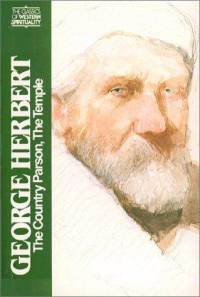
The Country Parson is a instructional book written from 17th century Anglican minister George Herbert in an attempt to describe and define the “perfect” country ministry. The same writer was a prolific poet and penned a generous volume of poems gathered and published as “The Temple”. Herbert is a brilliant academic figure, whose writing is surprisingly poignant and succinct, while remaining excellent pastoral guidance across the centuries.
Much in the tradition of Gregory the Great, whose “pastoral care” manual gave very specific and practical admonitions about human behavior, Herbert helps us understand how to properly lead the life of an Anglican priest and how it can be properly administered in a country parish. This is not so much an examination of the parishioner as it is a prescriptive agenda for various circumstances that may be encountered by the priest.
What is refreshing about Herbert immediately is his humility. Though the book is little more than 60 pages, he starts out with this abrupt stance to those who would theorise the ministry from an academic understanding:
Of those that live in the Universities, some live there in office, whose rule is that of the Apostle; Rom. 12.6. Having gifts differing, according to the grace that is given to us, whether prophecy, let us prophecy according to the proportion of faith; or ministry, let us wait on our ministring, or he that teacheth, on teaching, &c. he that ruleth, let him do it with diligence, &c. Some in a preparatory way, whose aim and labour must be not only to get knowledge, but to subdue and mortify all lusts and affections: and not to think, that when they have read the Fathers, or Schoolmen, a Minister is made, and the thing done.[1]
Such clarity of theology and praxis is still appropriate advice for us today. Herbert’s lessons to the pastor already serving are no less profound. One great example is his elevation of integrity as a duty for the minister to gain a hearing with his parishioners:
because Country people (as indeed all honest men) do much esteem their word, it being the Life of buying, and selling, and dealing in the world; therfore the Parson is very strict in keeping his word, though it be to his own hindrance, as knowing, that if he be not so, he will quickly be discovered, and disregarded: neither will they believe him in the pulpit, whom they cannot trust in his Conversation.[2]
Herbert teaches the minister to take the congregation as his barometer in all things. Preach using analogies they understand. Expound the textual meaning of a scripture, then communicate an application. Don’t preach too long. Divide your time up across a month and visit a quarter of the people in your congregation each week, thus seeing everyone personally in the span of each month in their own homes. Such practical wisdom is found on every page of Herbert’s book. All of this may sound mechanistic, but to a minister who is learning the craft of caring for people, it can be sound guidelines for beginning and understanding excellent common practices that can help frame a lifetime of ministry.
For sure, Herbert’s work is not to be taken as a exact template for every ministry or every circumstance. This is not his intention and we shouldn't be saddled by such expectations any more than us writing a book of practical wisdom for pastors today would be seen as useful in every aspect to ministers 300 years later from us. Accept and use what is good, but do not dogmatically undertake the book as a present-day regimen for all ministries.
Amazon Product Link: http://amzn.to/vLCyzi
Review by Kim Gentes
[1]George Herbert, “George Herbert: The Country Parson, The Temple”, (Ramsey, NJ: Paulist Press 1981), Pg. 55
[2]Ibid., Pg. 57
anglican,
classics,
country parson,
english,
george herbert,
ministry,
pastoral care,
the temple in
Book Review,
Counsel,
Leadership,
Ministry,
Theology
Sunday, October 23, 2011 at 11:26PM
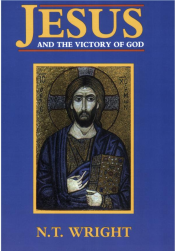
Reading and reviewing NT Wright's "Jesus and the Victory of God" is a monolithic task, as the book is both lengthy and highly academic. Its success is not in its volume of pages, however, but in its thorough treatment of Jesus and his work as historical fact leading to theological reality.
The portrait of Jesus of Galilee as the first century Jew who is both prophet/messiah is so profoundly unlike our 20th/21st Century thinking, that it is a shock treatment into the historical Jesus. It re-levels our Christian beliefs and theology from our arrogant "looking back on history" to a profound looking from the 1rst century forward, through the eyes of Judaism and its traditions and worldview. When we wake up from the shock, we find we are in a world that is thoroughly Jewish, thoroughly 1rst century, living as a conquered nation of Israel with its neck under the heel of the tyrannical Roman Empire.
Amongst a brood of 1st century revolutionary Zionists, Pharisees and "Jews-still-in-exile" within their own country, Jesus appears and draws on this climactic time, announcing in himself the arrival the kingdom-of-god message in which he comes to reconstitute the Temple, the Torah, and the Wisdom into his very person, reissuing their true essence into himself. At the same time, he redefines the true people of God not as a swipe against Israel but as a reinstatement of the core of its vocation and character- to be the light of the world.
Once the core of who Jesus is, what he intended, and what he actually did is redefined, the entire synoptic readings need complete reinterpreting, and Wright provides that as well, exploring the parables, symbols, actions and praxis of Jesus as both a means and expression to his brilliant thesis.
Product Link on Amazon: Jesus and the Victory of God
Review by Kim Gentes
Kim Gentes |
1 Comment |
book,
historical jesus,
history,
jesus and the victory of god,
narrative,
nt wright,
review,
scholar,
theology,
wright in
Bible,
Book Review,
Jesus,
Leadership,
Theology
Sunday, October 23, 2011 at 11:14PM
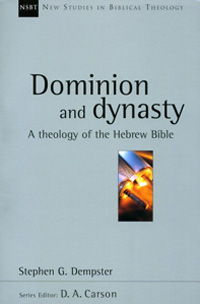
Dominion and Dynasty is a purposeful book meant to articulate the guiding narrative of the Hebrew scriptures by examining the original structure of Text (and texts within), re-envisioning a supportive literary approach as a hermeneutic for micro-interpretation within a macro-context, identifying the covenantal promises and blessings of land and lineage, and guiding the further interpretation of the narrative through understanding the symbols of Eden and David.
Structure to the narrative.
Reading through Stephen Dempster’s “Dominion and Dynasty” I found myself seeing the entire Old Testament (and the New Testament as well) as being a truly unified narrative. Previously, I had always read the Bible based on the modern day arrangement/order of books. Along with this, the text seemed to lack a coherent timeline, appeared ambiguous on so many referential levels and not seem to be part of a grander plot. The first profound change for me was to encounter Dempster’s explanation of the book order (and 3 groupings of books within) within the Tanakh. For the first time, I understood that the Hebrew Bible was architected as a narrative (even edited/ordered). It was grouped by three main sections within the overall volume- narrative, commentary, and concluding narrative. This may seem obvious or trivial to some, but in reading this one sentence below, my viewpoint of the Old Testament was changed forever:
The storyline begins with creation and moves to the exile of Judah in Babylon, from Genesis to 2 Kings; then the narrative is interrupted by poetic texts- largely prophecy, psalms and wisdom literature- before being resumed with Israel back in Babylon in the book of Daniel, moving on to the return of the exiles to Judah and concluding with a narrative summation of the entire history of Israel from creation to the exile in the books of Chronicles.[1]
Exegesis based on literary structure and synthesis.
With this introductory understanding of the structure of the Tanakh, I began to see a plan of the larger narrative of the entire Bible. Dempster pushes further on this point and holds that a broader literary approach to the Bible is itself a required hermeneutic for correct understanding of the specific texts in light of this larger, structured, progressive narrative.
Covenants of Land and Lineage.
The other major point that Dempster makes is that the major plot-line of the Hebrew Bible is centered on the covenant-making of God with individuals (primarily Adam, Noah, Abraham, David), tribes (the 12, and especially Judah) and nations (Israel). Specifically, this covenant-making pivots critically on two kinds of promise from God: provision and grants of land (dominion), and blessing and increase of the progeny of the covenantal figures (dynasty). In return, the human agents in those covenants were to agree to be bound to faithfulness in their devotion and service to Yahweh. God would give them land and children, if those in covenant with Him would remain faithful.
Lineage
Dempster is emphatic on this point of lineage, and it helps him explain why the Hebrew Scriptures have an insistence on including the genealogical record in key points of the narrative. He says:
A key purpose of genealogies in some contexts is to show a divine purpose that moves history to a specific goal.[2]
The book details the blessing of lineage as expressed through genealogy, especially in Genesis, where ten genealogical lists frame the movement of the storyline across both time and major characters.[3] In fact, the promise of descendants to Abraham becomes the pivotal salvation point for all of Israel, according to Dempster, when Moses is trying to plead for Israel’s sake against the judgment of God. Dempster says:
The sin forces God to threaten to destroy Israel in agreement with the covenant and to start again with Moses. But Moses pleads (certainly not on the basis of the recently broken Sinai covenant) on the basis of the descendants promised in the covenant with Abraham as grounds for saving Israel (Exod. 32:13). It is only this reason that decisively moves God to have mercy on Israel.[4]
Land
As much as the promise of descendants was a touch point of the promise made to Israel, so also was the identification with geographical space a sign of God’s blessing. Dempster highlights this extensively in his summation of Deuteronomy, where he says:
Consequently, the geographical motif is omnipresent. The final address of Moses to the people is saturated with references to the great prize awaiting possession. The land is at the forefront from the beginning to the end.[5]
The author is convinced that the Hebrew scriptures see the land as the clear external marker of both God’s blessing and Israel’s condition within the covenant. The various battles, successes and failures epitomise the faithfulness or sin of Israel, resulting in her consequence of acquiring or losing land. Dempster explains this at length in his section on the “Former Prophets”, where he talks both about the successes of faithfulness to the covenant:
The geographical nature of the promise is emphasized by the lengthy list of kinds and cities that were captured...what seems uninteresting to westerners was surely momentous to ancient Israelites. These were land deeds![6]
Likewise, later loss and rescinded access to the land (or rule over it) is seen as judgment for the break of covenant by Israel. This is highlighted when the author explains:
No sooner is the temple built and dedicated than it is duly noted that Solomon is guilty of polygamy, which leaders him to apostasy... The judgment that follows Solomon’s death splits the kingdom, dividing the tribe of Judah (and an assimilated Simeon) in the south from the ten northern tribes. With the failure of the Davidic scion, the promised land has begun to fragment.[7]
Thus, just as much as genealogy and descendants heralded God’s covenantal blessing, possession of land marked the barometer of Israel’s faithfulness (or failure) to that same covenant.
Major Narrative Symbols
Eden.
Symbols of Eden - from Egypt, to Sinai, to the exile, to Solomon and beyond the typology for Eden is cast throughout almost every major story of the Hebrew bible. Covenant building, human failure, restoration and a spiraling into further sin and consequential desolation is the Edenic archtype that pervades the Tanakh. Dempster sees the Eden image as a constant type that should be used to re-interpret later passages. For example, he treats Numbers 24:5-9 passage of Balaam’s blessing (3rd curse attempt) as if Edenic imagery is intended.
The passage draws from Eden and exodus imagery; Israel is compared to rivers and gardens, trees that the Lord has planted; the Israelite tents are like the trees planted by Yahweh. This was the divine intention when Israel was brought out from Egypt. It was to be planted in God’s mountain (Exod. 15:16); that is, it was to be returned to Eden.[8]
David.
David as the central character of the old Hebrew understanding of the complete man (Adam). David represented both the fulfillment of dominion and the blessing of dynasty that Israel could hold up as the archtype for their hope. And while Israel reaches her pinnacle in David/Solomon, even later hopes of restoration (for the sinful, broken Israel) come labeled as linked to the dynasty of David. It is a Davidic messiah that they wait for, a Davidic kingdom that they hope for politically, and Davidic dominion that they hope for militarily. Prophetic and narrative content replays David as the one on whom history pivots from the past into the future.
Dempster’s acute observations about the centrality of David to the Hebrew text is synthesized best in his last chapter. His description of the pinnacle role of David as a genealogical summation of humanity and a iconic figure that is hearkened back to by later generations (and texts) is clarified by the diagram on page 232, where he shows David as the pivot point of God’s efforts to draw humanity and creation back to himself.
These images of David and Eden, the covenantal components of land and lineage and the narrative structure (along with historical timeline) of the Hebrew scriptures are the key points of the excellent book, Dominion and Dynasty. Stephen Dempster has created an excellent guide for understanding how Jesus and the first century Jews may have understood the Hebrew scriptures. This is invaluable to those of us seeking to learn the context from which the message of Christ came forth, and gives us a greater understanding of what the New Testament writers were addressing through the gospel message and its revelation of Jesus as the Messiah who was to fulfill the Hebrew scriptures.
Product Link on Amazon: Dominion and Dynasty: A Theology of the Hebrew Bible
[1]Stephen G. Dempster, “Dominion and dynasty: a biblical theology of the Hebrew Bible”,(Downers Grove, IL: InterVarsity Press, 2003), Pg 22
[2]Ibid., Pg 47
[3]Ibid., Pg 55, 56
[4]Ibid., Pg 104
[5]Ibid., Pg 118
[6]Ibid., Pg 128
[7]Ibid., Pg 149
[8]Ibid., Pg 115,116
biblical studies,
dempster,
dominion,
dynasty,
hebrew bible,
narrative,
old testament,
theology in
Bible,
Book Review,
Theology
Sunday, October 23, 2011 at 10:18PM
Saint Teresa of Avila is another of the Catholic mystics who has profoundly impacted Christian formation/spirituality in the last 500 years. Like Therese of Lisieux, St. John of the Cross and others in the mystic tradition, Teresa of Avila takes a route of growth that focuses profoundly on the topic of love and uses the lens of introspection to probe the depths of the soul to find and purge inconsistencies for the person to find ultimate union with God.
To begin down this path Teresa defines an expanded understanding of the soul as a philosophically different and complete component to a human being, much in the Platonic/Geek dualistic model of separated body/spirit. Her exploration of this soul description begins with its magnitude.
In speaking of the soul we must always think of it as spacious, ample and lofty; and this can be done without the least exaggeration, for the soul's capacity is much greater than we can realize, and this Sun, Which is in the palace, reaches every part of it.[1]
But within this Platonic construct, the imagery and understanding of the soul is quite articulate and helpful. Teresa jumps immediately into the examination of the inner self. She finds in this inward journey, a more careful examination of the human condition, both as broken and beautiful agencies to the purpose of God. Again of this inward reflection, she says:
self-knowledge is so important that, even if you were raised right up to the heavens, I should like you never to relax your cultivation of it; so long as we are on this earth, nothing matters more to us than humility. And so I repeat that it is a very good thing -- excellent, indeed -- to begin by entering the room where humility is acquired rather than by flying off to the other rooms. For that is the way to make progress, and, if we have a safe, level road to walk along, why should we desire wings to fly? Let us rather try to get the greatest possible profit out of walking. As I see it, we shall never succeed in knowing ourselves unless we seek to know God: let us think of His greatness and then come back to our own baseness; by looking at His purity we shall see our foulness; by meditating upon His humility, we shall see how far we are from being humble.[2]
Teresa begins with the assumption that self-investigation is actually a way of expressing humility, since we are changed when we see the contrast between ourselves and God, our nature and God’s nature. In fact, for Teresa of Avila, humility is acquired by self-knowledge. For most individuals in modern culture, this type of approach would seem more selfish and less apt for personal change. But this is the gift of the mystic writers - they actually become the true inquisitors of their own hearts, who deal in honestly and expect you will as well.
What develops in this book particularly is a description of the soul as a series of unique mansions within mansions (something like a Russian doll configuration). The initial exterior mansions are representative of lesser levels of union with God, fraught with sin and seemingly regularly pulling people back to a starting of spiritual development largely due to a lack of freedom from sin and a continued unhealthy self-absorption. The interior mansions also correlate with levels of prayer progress that the adherent makes as they manage through these levels of mansions.
What anchors the mystics insistence on self-knowledge as a path to purity is their equally consistent trajectory of faith founded deeply in love. Love is the lynch-pin, the catalyst and end game for every point and sub-point of The Interior Castle, and the Avila saint says as much:
As I have written about this at great length elsewhere,I will not repeat it here. I only want you to be warned that, if you would progress a long way on this road and ascend to the Mansions of your desire, the important thing is not to think much, but to love much; do, then, whatever most arouses you to love. Perhaps we do not know what love is: it would not surprise me a great deal to learn this, for love consists, not in the extent of our happiness, but in the firmness of our determination to try to please God in everything, and to endeavour, in all possible ways, not to offend Him, and to pray Him ever to advance the honour and glory of His Son and the growth of the Catholic Church. Those are the signs of love; do not imagine that the important thing is never to be thinking of anything else and that if your mind becomes slightly distracted all is lost.[3]
If there is any problem with the approach of the saint of Avila, it is not in the sincerity of her heart or the assumption that she puts forth that we should have likewise. Instead, it may be simply in the belief that such great wisdom can be birthed from a person living a life in the convents and taken for use among people who live daily in the strain and grime of broken humanity as it exists outside of the cloistered communities of the monastic traditions.
Product Link on Amazon: The Interior Castle
Review by Kim Gentes
[1]Therese of Avila, “The Interior Castle”, translated E. Allison Peers (Radford, VA: Wilder Publications, 2008),Kindle Edition, Location 495
[2]Ibid., Location 509
[3]Ibid., Location 988
Monday, October 17, 2011 at 9:19PM
Thérèse de Lisieux - Mystic, Suffering or Neurotic Saint?
Through her own autobiography Thérèse de Lisieux appears to us as a childish and effusing figure, bent on achieving the goal of grand spiritualism and union with God. Her story is uniquely fit within the tradition of Catholic mystics, and was venerated to even higher status by the declaration of the title of Doctor which was given to her about a century after her death.
Therese wrote in a way which was predominantly introspective, especially with her early life. In fact, the maturity of her character is evidently one of the lessons she is trying to carry forward in the narrative- that her own writing and personal growth correspond to the readers journey into understanding the mystical truths she was conveying. However, since the entire autobiography was not written as a single volume, it would be too much to say that she envisioned this entire book as a single entity in the same way we now read it.
The reason that the content is important to this discussion is that it is so emotive and effusive that one can hardly read it without wondering whether it is real revelation or simply childish ranting. After reviewing the book, however, I have come to believe that Thérèse de Lisieux was both a physically and mentally pained person who overcame her suffering and eventually expressed her maturity in the writings of her autobiography. I believe that much of her early life and writing was, in fact, the strained emotional expressions of a suffering young woman. That said, she arrives eventually (in both age and wisdom) at such profound depth and fruitfulness of character that one must conclude that she did not retain her immature core.
The first several pages of the autobiography explain how Therese was compelled to write about her life from a request by her “mother” (who was actually her sister, a spiritual leader at her convent). The text explores her early years and recites what is little more than childish thoughts and actions. Crying, fits, dressing,playing with dolls and other childish musings. Her focus on God is clear from a young age, but frivolous and fanciful, as one would expect. Arduous as the first chapter is, the writing thereafter takes on a much more serious tone. This is primarily due to the constant trials, death and struggles that begin to broach the text. The death of Therese’s mother, difficulties with living with relatives, her fathers absence, physical illness and pain, the induction of all of her living sisters into a life of service in convents and the eventual death of her father are highlights of the seriousness of not only Therese’s life but the condition of the times in which her family lived. These difficulties galvanized the giddy school-girl into an intense (and perhaps morose) pre-teen/teen.
Physical Suffering
One difficulty that seems to almost be missed in the discussions of Therese is the gravity of her physical illnesses, which eventually take her life. While a completely different condition eventually kills her (tuberculosis), her earlier life has hints of possibility serious physical/emotional/neurological conditions which may have much to do with her formation, possibly her earliest visions and perhaps her ascent to the mystical life she was later venerated for. It is my belief that Therese’s early life was riddled with physical ailments that caused not only pain, but perhaps illusory understandings of God, even taking some of these experiences as the mystical revelations of the Holy Spirit.
The first evidence of this is directly found in Therese’s writing about herself:
Nobody could even say about me that “I was good when I was asleep,” because at night I was even more wiggly than during the day. I would send the covers flying, and then (asleep all the while) I would crash against the wood of my little bed. The pain would wake me up, and I would say, “Mama, I’ve been bumped.” My poor dear mother had to get up and establish that I did in fact have knots on my forehead, and that I had been bumped. She would cover me up securely and go back to bed. But after a short time I started being bumped again, so that they had to tie me in my bed. Every night, little Céline would come and tie the several cords that were intended to keep the little imp from getting bumped and waking up her mama. This method finally worked, so from then on I was good while I was asleep….[1]
This type of description is very consistent with a seizure, possibly an epileptic episode. The fact that she allowed herself to be tied down, tells us that she knew something was happening but she was unable or aware enough at the time to stop it. Having close relatives that suffer from epilepsy, this immediately came to mind when I read this account.
Other examples of pain that would at least effect mental faculties for Thérèse de Lisieux’s seem plentiful enough in the first section of the book--
Toward the end of the year I was taken with a headache that, though continual, almost didn’t make me suffer.[2]
and
As I was getting undressed I was taken with a strange trembling.[3]
as well as:
The next day he went to find Dr. Notta, who concluded, like my uncle, that I had a very serious illness that had never struck such a young child.[4]
and
And in fact He was, through the admirable resignation of my poor dear father, who thought “his little girl was going to go mad or that she was going to die.”[5]
and finally
It isn’t surprising that I was afraid that I looked sick without in fact being sick, because I would say and do things that I wasn’t thinking. I almost always seemed to be delirious, saying words that had no meaning, and nevertheless I’m sure that I wasn’t deprived for a single instant of the use of my reason…. Often I appeared to have fainted, not making the slightest movement. At that time I would have let be done to me anything anyone might have wanted, even kill me. Nonetheless I was hearing everything that was being said around me, and I still remember everything. It happened to me once that I stayed for a long time without being able to open my eyes, and yet I opened them for an instant while I was alone.[6]
Headaches, seizures, madness, fainting, unable to open/close eyes, being in your body but not in control of it- many of these symptoms are compatible with possible neurological/physical conditions that could certainly have induced the hysteria like symptoms that produce visions or other phenomena. I am not saying that none of her early experiences where genuine, but that this predominance of this kind of suffering can produce delusional episodes. Her familiarity with engaging in these could very well have been a “primer” of sorts to her later experiences and revelations.
But while Therese may have indeed suffered some illness the predisposed here neurological system to sensational experiences, her maturity as a thoughtful and dedicated follower of Christ becomes the long term proof of her character and her legacy.
Maturity through Suffering and Perseverance
Beginning with her desire to enter the convent, family confession, her first communion, her journey to enter the convent, and even her encounter with the Pope, Therese begins to expound on the internal condition of her heart as she moves through challenge after challenge. She reveals a ruthless tenacity to unearth any wrong motive, conjecture or misunderstanding about the nature of God, the humility of the servant or the nature of the work intended for her. For example:
One day during prayers I understood that my keen desire to make my profession was tinged with great self-love.[7]
Therese finds a mode where she is often stripping back what seems like a good desire and revealing an errant inner motive, such as above. Unlike what may be expected, she never stops her introspection with self loathing- it always leads to clear revelation of the reality of the situation and a certain action to be taken for its correction. She begins to put more and more importance on serving others, and even explains instances of her learning humility by serving older, cranky nuns. This kind of pure obedience to the process of maturity eventually turns Therese into a deeply pragmatic counselor, who eventually discounts the importance of dreams to a large degree:
I don’t attach any importance to my dreams, and besides, I rarely have any symbolic ones. And I even wonder how it is that, thinking all day long about God, I’m not more concerned with Him during my sleep…. Usually I dream about the woods, flowers, streams, and the sea, and almost always, I see pretty little children, and I catch butterflies and birds like ones I’ve never seen. You see, Mother, that if my dreams have a poetic appearance, they are far from being mystical….[8]
Therese evolves into a beautiful expositor of mystical and practical understanding, not coupling them together simply by Solomon-like wisdom, but by connecting them through the primary chord of her pursuit- the understanding of love as her primary vocation. This is what proves to me that Therese was not a romantic/dramatic narcissist- the truth and fruit of her ideas lead her to two things: a life of action that served others in humility; and a foundational belief in love as the primacy of the entire mystical and practical agenda of God and his encounters with all people.
This is seen in brilliant color in one of her most poignant quotes:
Just as Solomon, surveying all that his hands had done and what he had toiled to achieve, saw that everything was meaningless, a chasing after the wind [Eccl. 2:11], in the same way I recognized through EXPERIENCE that happiness consists only in staying hidden, in remaining in ignorance of created things. I understood that without love, all works are only nothingness, even the most dazzling, such as raising the dead or converting entire peoples [1 Cor. 13:1–3]…. Instead of doing me harm, leading me to meaninglessness, the gifts that God poured out on me (without my asking Him for them) led me to Him. I see that He alone is unchanging, that He alone can fulfill my immense desires….[9]
Jesus said that good trees bear good fruit, and that a bad tree cannot bear good fruit. Therese’s life produced an example of character and action that is a beautiful testimony to her centered understanding of the love of God. The further impact of her life and writings as an example and inspiration to millions are additional testimony to her integrity. I believe that Therese’s impact can be validated by the good tree / good fruit indicators that Jesus warned us to consider.
Jesus also told us that the central two commandments of the Christian life are hinged upon love (love God, and love your neighbor). As a follower of Jesus, it is no coincidence that Therese comes to this same conclusion about love.
Thérèse may indeed have been a romantic and dramatic neurotic in her earlier years, perhaps even a neurologically effected young girl. But her ultimate spirituality, though definitely introspective, proved to be anything but narcissistic. Her focused self-abasement and intractable desire to see Christ’s answer to every situation, drove her to understand and practice a life of sincerity and simplicity. Those qualities were left in her writing and her story and have definitely made a genuine spiritual advance for those who would avail themselves of her example.
Product Link on Amazon: The Complete Therese of Lisieux
Review by Kim Gentes
[1]Therese of Lisieux, “The Complete Therese of Lisieux”,translated Robert Edmonson (Brewster, MA: Paraclete Press, 2009),Kindle Edition, Location 615
[2]Ibid., Location 1160
[3]Ibid., Location 1165
[4]Ibid., Location 1169
[5]Ibid., Location 1173
[6]Ibid., Location 1194
[7]Ibid., Location 2646
[8]Ibid., Location 2810
[9]Ibid., Location 2887
Lisieux,
Robert Edmonson,
Therese,
book,
catholic,
mystic,
review,
the complete therese in
Book Review,
Counsel,
Leadership,
Loss,
Mystic,
Prayer